CANADIAN PORN KINGS, TOURISM “DEVELOPMENT” PROJECT, REPRESSION & THE VIOLATION OF INDIGENOUS-GARIFUNA RIGHTS IN HONDURAS
By Karen Spring, Rights Action, spring.kj@gmail.com
Canadian “Porn King” Randy Jorgensen’s tourism “development” projects are stirring up conflict and destroying afro-descendant Garifuna communities in Trujillo on the north coast of Honduras.
Jorgensen, president of the Canadian pornographic video store chain Adults Only Video (http://www.aovtv.com/, info@aov.ca, AOV, Suite 8, 2900 Argentia Rd, Mississauga, ON L5N 7X9, Canada), through his real estate development company Life Vision Properties (based in Trujillo, Honduras, http://www.lifevisiondevelopments.com/index.html), plans to convert a beautiful coastal area of Trujillo into a large scale tourism project that includes a series of vacation home developments and a cruise ship dock, displacing and destroying indigenous Garifuna communities.
Since 2008, the local Garifuna community organization, OFRANEH (Black Fraternal Organization of Honduras) has denounced that the “Porn King” and his Life Vision Properties are illegally purchasing land belonging and titled to Garifuna communities. (Since 1998, Rights Action has supported the community development, environmental defense and human rights work of OFRANEH)
The Garifuna are an indigenous people descendants of Arawak native Americans and escaped African slaves. For years, OFRANEH and the 46 Garifuna communities on the north coast of Honduras have been battling the very same “tourist development” interests that Randy Jorgensen promotes in Trujillo (1).
Communally owned land, an essential part of Garifuna culture, rights and community well-being, is constantly under threat by interests ranging from Honduran government officials, organized crime, international “development” institutions (Inter-American Development Bank) and foreign investors (like the Porn King). All of these have used various illegal, brutal and/or manipulative means to appropriate ancestral Garifuna lands, interested in exploiting it in the name of economic “development” and tourism, despite national and international law that obligates the full recognition and respect of indigenous collective land rights.
Also disturbing to Honduran communities is Jorgensen’s sordid legal history. Canada’s Macleans magazine reported in 2001 that Jorgensen had been “accused of making X-rated films with underage girls in his vacation home in Honduras” (2).
This is very worrying, considering his home in Trujillo, located within the Life Vision project confines, neighbours an orphanage, in a country with high levels of impunity and little political will to persecute wealthy locals and foreigners for their criminal activities.
CANADIAN PORN KING PILLAGING THE CARIBEAN COAST
Jorgensen and his Life Vision Development company have plans to build a series of gated communities marketed to Canadian and US citizens between the coastal towns of Trujillo and Betulia - Alta Vista, Campa Vista, Coroz Alta and New Palm Beach - and a cruise ship port called ‘Banana Coast’ in Trujillo, which is scheduled to begin construction in March 2011(3)
Jorgensen and his associates seem to benefit from every stage of the Trujillo coast “development”: they acquire the land, construct the vacation homes, promote the project and sell properties in Canada. Life Visions buys land and sells properties. Jorgensen’s construction company, Jaguar Construction, builds the homes.
The “Banana Coast” port is owned by the Trujillo Grande Authority (GTA), a consortium between Life Vision, the Municipality of Trujillo and Global Destinations Developments, a Miami tourism promotion company. Jorgensen sits on the GTA Board of Directors (4). The GTA consortium will facilitate the expected $15 million investment needed to construct the “Banana Coast” port.
On February 6, 2011 a Honduran newspaper reported that GTA signed an agreement with the last remaining Garifuna landholders who had refused to sell their lands, giving the “green light” to start construction. The agreement was reached with the assistance of a government commission that in included Ramon Lobo, the brother of ‘de facto’ President Porfirio “Pepe” Lobo.
TOURISM & REPRESSION
Pepe Lobo ordered thousands of Honduran troops to occupy the North Coast region, which includes Trujillo, in March 2010, where corruption in the administration of justice (following the June 2009 military coup that ousted the democratically elected government of President Zelaya, and opened the way for de facto regime leader Pepe Lobo to become President) ignited land conflicts which had been in the process of resolution. Other land conflict negotiations in the region have been marked by the detention, kidnapping and torture of campesino advisors, and dozens of campesinos have been killed.
The same area where Life Vision plans to build vacation homes has been heavily militarized by Honduran regime forces since the military coup. Just 20 minutes away from one of the Porn King’s proposed project sites, five campesinos were massacred on November 15th, 2010 by private security guards of large land owner Miguel Facusse.
DISAPPEARANCE OF THE GARIFUNA COMMUNITY OF RIO NEGRO & OTHERS UNDER THREAT
The Banana Coast cruise ship port will be built in the Garifuna community Rio Negro, just footsteps away from the home of one of six Garifuna men who for years refused to sell his lands. Under many pressures as the community disappears and as their neigbour’s houses are being bulldozed to the ground, residents of Rio Negro found it difficult to hold on.
An hour down the dirt road that connects Rio Negro to Trujillo, three other communities where many Garifuna and Pech (another indigenous people) families live, is the community of Guadalupe. On the western edge of Guadalupe, Jorgensen and Life Visions have begun selling land plots for their Alta Vista project after successfully selling a reported 200 lots in 90 days to Canadian families in their Campa Vista site located on the same dirt road closer to Trujillo.
Community representatives in Guadalupe report that “the Canadians” or testaferros (Honduran nationals that act on behalf of the Canadians and buy the land in their name) regularly pass through the community and have visited various individuals asking if they want to sell their land.
To date, 141 acres within the Guadalupe land title has been acquired by Life Vision Properties for their 292-acre Alta Vista project for a total price of 150,000 lempiras or $7,500 USD. Besides being in violation of Garifuna-indigenous community rights, these are extremely low prices considering Life Development Properties are advertising and selling their 0.4 acre-size lots in Canada starting at $30,000.
“PURCHASES” OF GARIFUNA LAND IN VIOLATION INTERNATIONAL LAW
What Jorgensen and Honduran authorities ignore is that individual land plots cannot legally be purchased within Garifuna communities, or owned or rented by someone outside of the Garifuna community itself.
International law is clear that “development” projects, such as those advanced by Life Vision Properties (with the assistance of the regime put into power by a military coup), cannot be implemented without the free, prior and informed consent of the affected indigenous (Garifuna) communities. As part of this legal requirement, States are obliged to recognize indigenous communal lands.
A Garifuna authority from a directly impacted community, who forms part OFRANEH, describes the lack of consultation and information that has been given to the communities about the projects:
“We have our own traditions, customs, but they [the Canadians] aren’t respecting our traditions as an ethnic group. We, as an organization, are in a process to rescue our culture and here [in Rio Negro], there is a process of cultural destruction going on. For example, the Canadians come here and buy up a huge amount of land that is part of our communities. Sociologically, development does not come from outside, it comes from within the community, is constructed locally and from the bottom-up.”
A “NATURE PARK” RESULTING IN MORE ENVIRONMENTAL DESTRUCTION
According to OFRANEH, many of the planned “tourist development” projects will be built in the buffer zones of protected areas of the Capiro and Calentura mountains and will cause deforestation and destruction in a zone that is highly vulnerable to natural disasters (5).
Despite the environmental destruction that its tourism apparently will promote, Life Vision advertises an “ecological” side to its ‘development.’ It will build a ‘Nature Park’ that’s primary mission is the “preservation and rehabilitation of Honduras’ native fauna.” Under the banner of conservation, these projects will contribute to environmental destruction, as OFRANEH has denounced before the Ministry of Ethnics and Ministry of the Environmental, the Honduran government bodies responsible for regulating such projects(6).
OFRANEH has denounced environmental damages and deforestation that will be caused by the Alta Vista project and the illegitimacy of the environmental license issued by the Honduran Secretary for the Environment and Natural Resources, SERNA, for the Alta Vista project during the final days of de-facto leader Roberto Micheletti and his regime that took power following the military coup that ousted President Zelaya (7).
Micheletti’s regime committed various acts of brutal repression against the anti-coup social movement and pro-democracy people’s movement that formed after the coup. The Micheletti regime has also been implicated in corruption scandals, including a Wikileaks’ memo written by US Ambassador in Honduras, Hugo Llorens, for various acts of corruption, including attempting to illegally grant concessions to an Italian company interested in a hydro-electric dam project in southern Honduras.
“CHARTER CITY”: GIVING A PIECE OF HONDURAS TO FOREIGN GOVERNMENTS & COMPANIES
In the last month, the Honduran Congress, controlled by the Pepe Lobo regime (“elected” in illegitimate elections after the June 28th, 2009 military coup), approved a law that would allow the creation of “Model Cities” within Honduran territory.
The Model City project, promoted by US economist Paul Romer, would allow for 33 km-squared city to be built within Honduran territory but governed by foreign governments or investors. The city would have its own justice system, constitution and private security forces that would not be subject to Honduran laws.
All of this is a more extreme version of a “free trade zone” or “special administrative region.”
According to various Honduran newspapers and Government officials, Trujillo is considered a perfect location for a model city, from Puerto Castillo-Trujillo-Santa Fe to Betulia, the same land strip where Jorgensen and Life Vision Properties are “developing” tourism projects and displacing Garifuna communities. Some speculate Jorgensen’s cruise ship port, expected to be up and running by 2012, is an essential part of the proposed Model City government officials are proposing for Trujillo.
Many Honduran activists and grassroots organizations have denounced the Model City proposal calling it a form of neo-colonialism, comparing it to Henry Ford’s failed Fordlandia in Brazil, also questioning that the project may be a money-laundering scheme. Newspaper reports claim that unknown investors from the Cayman Islands have shown interest in the project. The Cayman Islands are infamous for secretive banking procedures that hide the identities and sources of income for individuals and corporations. Recently Wikileaks was given documents from Cayman Island banks that it has promised to expose in the coming months.
The connection between the Canadian real estate development interests and those promoting the Model City is not clear, though both seem to share intensions for the land located between Trujillo and Betulia on the north coast.
Unfortunately, Model Cities, Porn King Randy Jorgensen and Canadian property development projects, or all of the above, present the same threat to the Garifuna and campesinos communities living on the project site and near Trujillo. The projects bring displacement and illegal appropriation of Garifuna land essential for their survival, … in the name of “development”.
(Karen Spring works for Rights Action (www.rightsaction.org) and lives in Honduras. spring.kj@gmail.com. Feel free to re-publish this article, citing author and source.)
***
Translation of Article from Honduran newspaper, La Prensa.
"PORN KING", DEVELOPER OF PROJECTS IN TRUJILLO
http://www.laprensa.hn/Apertura/Ediciones/2011/03/07/Noticias/Empresario-de-la-pornografia-dirige-proyectos-en-Trujillo
Honduras, 06.03.2011
[Translation for Rights Action by Rosalind Gill, RGill@glendon.yorku.ca]
In Canada, Randy Jorgensen is a leader in the pornography industry. In Honduras, he is CEO of the company that will build a new cruise ship terminal.
Until recently, Trujillo was the lost paradise of Honduras, a uniquely beautiful city waiting to be discovered by the outside world. Today, at last, Trujillo's dream has come true - a cruise ship terminal will be built in the city, allowing people from all over the world to experience the unforgettable beauty of the place. As well, there are plans for four housing projects that will allow tourists to own a quality house in Trujillo and come back to this paradise every year.
After years of being forgotten, suffering from the indifference of governments that never did anything to develop the area, Trujillo is becoming a mega-project centre. Looking at this promising situation, you can only hope that no "villains" appear on the scene, but unfortunately, a few first class villains have indeed turned up.
And Randy is our number one villain.
In fact, all the mega-projects in Trujillo are being developed by Randy Jorgensen.
The Grand Trujillo Authority Consortium is developing the Banana Coast Cruise Ship Terminal in the Río Negro neighbourhood; and the four housing projects for Canadian and American tourists are being developed by the Life Vision Properties Company.
In Honduras, Randy Jorgensen is known as CEO of both these companies, which are backed by Fast Track Capital, a Canadian investment group. But there is a lot more to Randy's story than that of the typical successful investor looking for new ways to make money in exotic countries.
Miriam Miranda, Director of OFRANEH (Honduran Black People's Fraternal Organization) provided us with some details about Jorgensen's life: "He is known as the "King of Porn", and has even had problems with the law. Here in Honduras, authorities have allowed him to go ahead and harm protected areas. We have been denouncing this for some time now but nobody has done anything because the only thing that counts here is money," said Miranda.
FOUNDER OF AOV (Adult Only Video)
There are innumerable web pages, mostly in English, that provide details on Jorgensen's activities. Randy Jorgensen was born in Canada, a country where he is known as the "King of Porn". He is the founder of Adult Only Video (AOV), Canada's biggest pornography retail chain.
"The only problem I have had in Honduras was with an ex-employee who was caught stealing and tried to make accusations against me to avoid facing charges but they turned out to be false allegations and she had no proof to present to the Court."
OFRANEH, a Garífuna organization, tried to accuse me of buying land illegally, but the case was not deemed valid by the Public Ministry," said Randy, who agreed to talk to the newspaper, LA PRENSA.
Sonia Parra revealed in the International Press Service that the Capiro and Calentura protected areas were at risk because of the housing projects being developed by Randy. As well, other serious matters concerning Jorgensen's activities have been raised.
On January 26, 2011, the bank holding his company's funds informed him that all his accounts would be closed and he was given limited time to withdraw his capital. "This cannot be because of money-laundering or drug-trafficking, because if that were the case, my funds would have frozen. All the letter says is that the law allows them to close an account if they see fit", said the Canadian businessman.
SUPPORT FOR JORGENSEN'S PROJECTS
Final approval for the cruise port was given at the time when the country was experiencing political turmoil. Luis Alonso López was Mayor in the former municipal administration of Trujillo. On December 10, 2009, this administration declared that the cruise port was a necessary public utility for Río Negro. Final authorization for the project was granted just five days before Porfirio Lobo became President. The official announcement was published in the January 22, 2010 of La Gaceta (official Government publication).
This edition of La Gaceta provoked a controversy known as the "Gacetazo", because on that day, two versions of the bulletin were printed, only one of which included the decree authorizing the highly disputed concession for the Nacome dam.
The environmental permit for the construction of the Alta Vista Beach project, a tourist housing development, was granted on January 25, two days before the termination of the former Government.
The Life Vision Properties blog states that President Porfirio Lobo invited Jorgensen to meet him at the Christopher Columbus Hotel in Trujillo on November 27, 2010. The meeting was attended by a number of civil servants, including Ramón Lobo, the President's brother and advisor.
According to the company blog, details of Randy's tourist projects were discussed at the meeting. In the end, Lobo instructed his ministers and José Laínez, the Mayor of Trujillo, to do their best to ensure that the projects be implemented as quickly as possible.
OPINIONS OF COMMUNITY MEMBERS
After a life of economic difficulty, unemployment, low opportunity and urban stagnation, inhabitants of Trujillo are not really interested in the identity of those who will carry out the development projects. The only thing they are concerned about is that the development does go ahead. These programmes bring hope for improvement in their quality of life - a change this humble city has long awaited.
However, some people, like Miriam Miranda, cannot understand why the future of Trujillo's tourism would be put in the hands of a porn industry magnate.
DETAILS OF THE AGREEMENT
According to Randy Jorgensen, the profit share is fair and everything was carried out according to the law. "Our investment group receives 50% of profit, the Municipality of Trujillo receives 20%, community members of Río Negro will receive 10% and the remaining 20% will be available for possible new investors", said the Canadian. Jorgensen also said that they expect the land part of the project to be ready by 2012, while the maritime part will take 18 months.
Randy revealed that he has received bids from three companies for the construction and supervision of the terminal. The companies are not from Trujillo because the area cannot offer services at that level.
Jorgensen also said that the investment group he represents did not choose Trujillo by chance - the decision was based on tourist studies carried out by the Honduran government several years ago. He pointed out that the city should prepare itself for the big change that is coming. For Jorgensen, a highlight of the contract is the possibility that in 20 years, the Municipality will have the opportunity to buy the rights that belong to Canadian investors at this point.
Protests or no protests, on March 11, ground will be broken to begin construction on the cruise Terminal. President Lobo is expected to attend the event.
"My company did not produce or make the films, we just sold them."
Some people in Honduras are scandalized by him while others see him as a model of a visionary business man, but no one is indifferent to him. Randy Jorgensen founded Adult Only Video (AOV) in Saskatoon, Canada, a country where the porn industry is legal.
"The company is a chain of retail stores, not a production or film company. From 1980 to 1990, I worked with several provincial and federal film boards in Canada to create viable standards for the adult video industry, so that an illegal market would not develop," said Randy.
In only seven years, his retail business went from being a small local store to a business with 500 employees, according to the Canadian magazine, MacLean's. "MacLean's did a report on me and my company in 1993. It was they who gave me the name "King of Porn". The article was very favourable and gave a positive evaluation of my work to create fair standards to ensure that the industry remains regulated and legal", said Jorgensen.
According to business magazines, the porn business is so profitable that it remained stable, even during the recession. "The name "King of Porn" does not bother me, what does bother me is when they base their opinion on rumours or half-truths", said the Canadian.
Because of the growth of pornography in Canadian culture, Canadian authorities have had to keep revising and modifying laws governing videos and explicit content material and they have had difficulty defining with precision the different situations that can arise in these productions. There is no way of counting the number of users of pornography but the profits are an indicator of the money that can be made with this type of material.
Finally, Randy spoke of his wishes for Honduras. "This is one of the poorest countries in the Western hemisphere and it has a high level of illiteracy. Tourism is the fastest way to fight these problems. I would like to see the introduction of a general education system and the creation of an economy that will give the youth of Honduras a fair chance at life so that they will not have to leave Honduras to improve their lot. For the past four years, I have worked to make the Trujillo Bay project a reality", said Jorgensen.
Friday, March 11, 2011

Monday, January 17, 2011
Sweatshops, Mining, Tourism & "Free" Trade Negotiations: Canada's Involvement in Honduras & Support for the Post-Military Coup Regime
BELOW: an article by Karen Spring, Rights Action
“The Canadian government and mining companies that were granted concessions before the moratorium are waiting for the green light to get the digging started. A new mining law and/or trade agreement would be their green light. The Canadian government is aware of this and by holding out millions of dollars in investments and possibly a trade agreement, it hopes to sway the Honduran government in their favour.”
KAREN SPRING SPEAKING TOUR TO ONTARIO & MANITOBA, February 2011. For more information, or to host a speaking event, contact: Karen (spring.kj@gmail.com).
TO JOIN AN EDUCATIONAL DELEGATION TO HONDURAS (MARCH 19-27 or MAY 14-22), contact: Karen Spring (spring.kj@gmail.com) or Grahame Russell (info@rightsaction.org).
Please re-publish this article, citing author and source
* * * * * * *
SWEATSHOPS, MINING, TOURISM & “FREE” TRADE NEGOTIATIONS:
CANADA’S INVOLVEMENT IN HONDURAS & SUPPORT FOR THE POST-MILITARY COUP REGIME
By Karen Spring (spring.kj@gmail.com), January 10, 2011
Canada and the United States are the two most active legitimizers of the June 28, 2009 military coup in Honduras, and, since then, the post-coup regime.
Neighbor to the United States, Canada often escapes critical attention to its unjust global economic and political ventures. However, Canada is making its complicit involvement in post-coup Honduras increasingly obvious through Canada’s sweatshop, mining and tourist interests in the country.
Recently, the Canadian government publicized plans of negotiating a so-called “free” trade agreement with Honduras. (There is nothing “free” about any trade) Branching off from the thus far unsuccessful negotiations of the Canadian-Central American “free” trade agreement (CA4), involving Guatemala, Nicaragua, El Salvador and Honduras, Canada has begun laying out plans for a Canadian-Honduran bi-lateral “free” trade agreement. Honduran officials from the post-military coup regime arrived in Ottawa in early December 2010 and are set to continue negotiations in early 2011.
Canadian business and investment interests in Honduras did not just begin after the June 2009 coup – they simply have continued with business as usual.
In April 2010, Canadian Ambassador Neil Reeder arrived in Honduras to meet with Pepe Lobo, leader of the regime that was ‘elected’ in fraudulent and illegitimate elections five months after the coup (see article “A Good Investment Opportunity: Canadian Government & Mining & Sweatshop Business Executives Meet with Honduran Regime”, by Grahame Russell, at www.rightsaction.org, http://rightsaction.org/Alerts/Good_investment_040810.html). With mining and business executives and investors in tow, Ambassador Reeder dangled the hope of $700 million in investments in the Honduran mining and sweatshop industries, clarifying Canada’s future economic ambitions in the country.
As trade agreements and investments are being planned and promised, Canada effectively ‘whitewashes’ the military coup, the illegitimate elections of November 2009, ignores well-documented human rights violations and repression carried out by the Lobo regime and dismisses the existence of the pro-democracy, anti-coup people’s movement that demands major structural changes and the re-foundation of Honduras including the drafting of a new constitution.
(For more on Canada’s position following the coup, see Yves Engler’s article, “Hostility to the Military Coup in Honduras is Increasing. So is the Harper government’s isolation on the Issue”, or Rights Action’s Honduran Alert #41, “In Response to Mr. Peter Kent: Canada’s Increasingly Complicit Role in Honduras.”)
FUNDING & PARTICIPATING IN THE HONDURAN REGIME’s ‘TRUTH COMMISSION’
Honduras was kicked out of the Organization of American States (OAS) shortly after the June 2009 coup and has not been re-admitted. Re-admission would bring many benefits to the Lobo regime including ‘business as usual’ trade, international loans and most importantly, international recognition and the stamp of approval as a Government and Congress that pulled off a military coup.
One condition of OAS re-admission is a ‘reconciliation process’ that includes a Truth Commission to investigate the events leading up to, during and after the coup against President Zelaya’s government.
However, the OAS did not have in mind a Truth Commission set up and controlled by the post-coup regime, which is exactly what is happening. Not only is the Canadian government helping fund the Honduran regime’s “truth” commission, but a former Canadian official, lawyer Michael Kergin, is on the commission.
What is the problem with the regime’s “truth” commission? Not one social or human rights organization that was affected by or spoke out against the military coup is participating or recognizing it. Victims and families of the victims of repression, torture and murder since the coup have not been consulted nor are participating, calling it a ‘Lie Commission’ and an opportunity for the Lobo regime to try and gain international recognition, leaving all crimes committed during and after the coup covered up with in impunity.
As a former Ambassador to the United States, Michael Kergin apparently has strong ties with the Canadian mining industry through his work at the Bennett Jones law firm in Toronto. A coincidence? Not likely. In fact, it seems in line with the promotion of one of Canada’s major interests in Honduras: Mining.
A MINING LAW & TRADE AGREEMENT FAVOURING CANADIAN MINING COMPANIES WILL INCREASE SOCIAL CONFLICT & REPRESSION
The resistance of mining-affected communities and organizations to the environmental and health harms and other human rights violations caused by large-scale mining, and their formation of a national alliance – the Civil Alliance for Democracy – was one reason that President Zelaya’s government enacted a 2008 moratorium on handing out further mining licenses.
Everyone in Honduras’ pro-democracy movement lists the mining moratorium as one of the reasons the Honduran military, oligarchy and Catholic Church conspired to oust his government in the June 28, 2009 coup.
Rights Action has for years reported on the harms and violations caused directly and indirectly by Canada’s Goldcorp’s open-pit, cyanide-leeching operation in the Siria Valley. Rights Action has also denounced Goldcorp and other companies for helping to support and ‘whitewash’ the military coup and the ensuring repression.
Since the enactment of the mining moratorium during President Zelaya’s administration, new mining operations cannot begin in Honduras until the Lobo regime approves a new mining law. Today, the post-coup regime has two options, approve a law that is shaped by the demands of the mining harmed communities, many of which are involved in the pro-democracy people’s movement, or give into the demands of the Honduran oligarchy and global mining companies and investors and approve a law that favours mining companies.
A law favouring mining companies will likely include few or no environmental regulations, will likely permit the continued use of cyanide and low-cost, open pit processes, will likely provide large tax breaks, and will not oblige companies to consult and obtain the free and prior consent of local communities before initiating their mining operations.
The Canadian government and mining companies that were granted concessions before the moratorium are waiting for the green light to get the digging started. A new mining law and/or trade agreement would be their green light. The Canadian government is aware of this and by holding out millions of dollars in investments and possibly a trade agreement, it hopes to sway the Honduran government in their favour.
If a pro-mining law is passed, one thing is clear: ignoring the affected communities and demands of the pro-democracy people’s movement regarding community consultation, inclusion and protection of the environment will result in increased social conflict, repression, extrajudicial killings, death squads, torture and environmental degradation.
HOTELS & CRUISE SHIPS: CANADIAN INTERESTS IN TOURISM
In November 2010, five campesinos were massacred by private security forces hired by land-owner Miguel Facusse in the Aguan region in Northern Honduras. (See Annie Bird’s article, “World Bank funded Biofuel Corporation Massacres 5 Honduran Compesinos”, www.rightsaction.org).
Land conflicts, militarization of the region, threats, disappearances and physical beatings - particularly in the community of Guadalupe Carney – continue in 2011, most recently with the illegal kidnapping and beating-torture of Juan Chinchilla.
No more than 20 minutes from the November 15 massacre site, and while the militarization of the region goes on, Canadian ‘porn king’ Randy Jorgensen hopes to build a $15 million port in the coastal city of Trujillo to receive cruise ships and to build a four-park tourist attraction that includes hotels, a shopping centre, and more.
Jorgensen is involved in various other tourist projects on the north coast of Honduras along with other Canadians who hope to develop retirement communities and tourist attractions. (For more information on the Canadian ‘porn king’, see article by Dawn Paley, “Snowbirds gone wild! Canadian Retirees and Locals Clash in Honduras”).
In November 2009, 5 months after the military coup, Rights Action reported on a letter writing campaign initiated by pro-coup North Americans living on Honduras’ north coast and the Bay Islands – including Roatan -, to pressure the US and Canadian governments to effectively support the coup, by legitimizing the post-coup regime led by Roberto Micheletti. (See Rights Action’s Alert #89 “Pro-Coup North Americans in Honduras”, www.rightsaction.org).
These North Americans were trying to convince their governments that State-sponsored repression was not occurring in Honduras and that tourist and travel advisories should be lifted. Many of the letter writers operate ‘property development’ projects and businesses in the tourist industry.
Often, tourist projects scattered along Honduras north shore are managed and owned by Canadians who are in conflict with local campesino and Garifuna communities. As an industry that can attract foreign investment, the Honduran regime today is more than willing to promote tourism and accommodate the Canadians, generating social and land conflict with local Honduran communities, displacing and threatening the livelihood of the Garifuna communities and contributing to environmental degradation.
INJURED SWEATSHOPS WORKERS: CANADA’S GILDAN REFUSES TO TAKE RESPONSIBILITY
Based in Montreal, Gildan Activewear is a major producer of clothing apparel and one of the three dominant, low-wage sweatshop companies operating in Honduras. Many Canadian and American universities and colleges have contracts with Gildan that supplies clothing apparel to their athletic departments and sports teams.
Unfortunately, the Canadian company has a rotten history in Honduras. Many women working in Gildan sweatshops in Honduras have reported serious injuries including musculo-skeletal problems caused by the repetitive work in the factories. Some have reported major accidents that have caused permanent damage. Although Gildan has full knowledge of the women that have been injured in their factories, they refuse to accept responsibility and appropriately compensate the injured women. Many of these women cannot afford to feed their families and pay the high medical costs as a result of their injuries.
* * *
Often slipping below the radar next to the United State’s historic economic interests and military interventions in Honduras, Canada is now working hard to help the illegitimate Lobo regime gain international recognition. Why? Because major Canadian business and investment interests are on the line. The Canadian government, businesses and investors are showing they do not care that they are supporting an undemocratic and repressive regime.
(By Karen Spring, Rights Action, spring.kj@gmail.com)
“The Canadian government and mining companies that were granted concessions before the moratorium are waiting for the green light to get the digging started. A new mining law and/or trade agreement would be their green light. The Canadian government is aware of this and by holding out millions of dollars in investments and possibly a trade agreement, it hopes to sway the Honduran government in their favour.”
KAREN SPRING SPEAKING TOUR TO ONTARIO & MANITOBA, February 2011. For more information, or to host a speaking event, contact: Karen (spring.kj@gmail.com).
TO JOIN AN EDUCATIONAL DELEGATION TO HONDURAS (MARCH 19-27 or MAY 14-22), contact: Karen Spring (spring.kj@gmail.com) or Grahame Russell (info@rightsaction.org).
Please re-publish this article, citing author and source
* * * * * * *
SWEATSHOPS, MINING, TOURISM & “FREE” TRADE NEGOTIATIONS:
CANADA’S INVOLVEMENT IN HONDURAS & SUPPORT FOR THE POST-MILITARY COUP REGIME
By Karen Spring (spring.kj@gmail.com), January 10, 2011
Canada and the United States are the two most active legitimizers of the June 28, 2009 military coup in Honduras, and, since then, the post-coup regime.
Neighbor to the United States, Canada often escapes critical attention to its unjust global economic and political ventures. However, Canada is making its complicit involvement in post-coup Honduras increasingly obvious through Canada’s sweatshop, mining and tourist interests in the country.
Recently, the Canadian government publicized plans of negotiating a so-called “free” trade agreement with Honduras. (There is nothing “free” about any trade) Branching off from the thus far unsuccessful negotiations of the Canadian-Central American “free” trade agreement (CA4), involving Guatemala, Nicaragua, El Salvador and Honduras, Canada has begun laying out plans for a Canadian-Honduran bi-lateral “free” trade agreement. Honduran officials from the post-military coup regime arrived in Ottawa in early December 2010 and are set to continue negotiations in early 2011.
Canadian business and investment interests in Honduras did not just begin after the June 2009 coup – they simply have continued with business as usual.
In April 2010, Canadian Ambassador Neil Reeder arrived in Honduras to meet with Pepe Lobo, leader of the regime that was ‘elected’ in fraudulent and illegitimate elections five months after the coup (see article “A Good Investment Opportunity: Canadian Government & Mining & Sweatshop Business Executives Meet with Honduran Regime”, by Grahame Russell, at www.rightsaction.org, http://rightsaction.org/Alerts/Good_investment_040810.html). With mining and business executives and investors in tow, Ambassador Reeder dangled the hope of $700 million in investments in the Honduran mining and sweatshop industries, clarifying Canada’s future economic ambitions in the country.
As trade agreements and investments are being planned and promised, Canada effectively ‘whitewashes’ the military coup, the illegitimate elections of November 2009, ignores well-documented human rights violations and repression carried out by the Lobo regime and dismisses the existence of the pro-democracy, anti-coup people’s movement that demands major structural changes and the re-foundation of Honduras including the drafting of a new constitution.
(For more on Canada’s position following the coup, see Yves Engler’s article, “Hostility to the Military Coup in Honduras is Increasing. So is the Harper government’s isolation on the Issue”, or Rights Action’s Honduran Alert #41, “In Response to Mr. Peter Kent: Canada’s Increasingly Complicit Role in Honduras.”)
FUNDING & PARTICIPATING IN THE HONDURAN REGIME’s ‘TRUTH COMMISSION’
Honduras was kicked out of the Organization of American States (OAS) shortly after the June 2009 coup and has not been re-admitted. Re-admission would bring many benefits to the Lobo regime including ‘business as usual’ trade, international loans and most importantly, international recognition and the stamp of approval as a Government and Congress that pulled off a military coup.
One condition of OAS re-admission is a ‘reconciliation process’ that includes a Truth Commission to investigate the events leading up to, during and after the coup against President Zelaya’s government.
However, the OAS did not have in mind a Truth Commission set up and controlled by the post-coup regime, which is exactly what is happening. Not only is the Canadian government helping fund the Honduran regime’s “truth” commission, but a former Canadian official, lawyer Michael Kergin, is on the commission.
What is the problem with the regime’s “truth” commission? Not one social or human rights organization that was affected by or spoke out against the military coup is participating or recognizing it. Victims and families of the victims of repression, torture and murder since the coup have not been consulted nor are participating, calling it a ‘Lie Commission’ and an opportunity for the Lobo regime to try and gain international recognition, leaving all crimes committed during and after the coup covered up with in impunity.
As a former Ambassador to the United States, Michael Kergin apparently has strong ties with the Canadian mining industry through his work at the Bennett Jones law firm in Toronto. A coincidence? Not likely. In fact, it seems in line with the promotion of one of Canada’s major interests in Honduras: Mining.
A MINING LAW & TRADE AGREEMENT FAVOURING CANADIAN MINING COMPANIES WILL INCREASE SOCIAL CONFLICT & REPRESSION
The resistance of mining-affected communities and organizations to the environmental and health harms and other human rights violations caused by large-scale mining, and their formation of a national alliance – the Civil Alliance for Democracy – was one reason that President Zelaya’s government enacted a 2008 moratorium on handing out further mining licenses.
Everyone in Honduras’ pro-democracy movement lists the mining moratorium as one of the reasons the Honduran military, oligarchy and Catholic Church conspired to oust his government in the June 28, 2009 coup.
Rights Action has for years reported on the harms and violations caused directly and indirectly by Canada’s Goldcorp’s open-pit, cyanide-leeching operation in the Siria Valley. Rights Action has also denounced Goldcorp and other companies for helping to support and ‘whitewash’ the military coup and the ensuring repression.
Since the enactment of the mining moratorium during President Zelaya’s administration, new mining operations cannot begin in Honduras until the Lobo regime approves a new mining law. Today, the post-coup regime has two options, approve a law that is shaped by the demands of the mining harmed communities, many of which are involved in the pro-democracy people’s movement, or give into the demands of the Honduran oligarchy and global mining companies and investors and approve a law that favours mining companies.
A law favouring mining companies will likely include few or no environmental regulations, will likely permit the continued use of cyanide and low-cost, open pit processes, will likely provide large tax breaks, and will not oblige companies to consult and obtain the free and prior consent of local communities before initiating their mining operations.
The Canadian government and mining companies that were granted concessions before the moratorium are waiting for the green light to get the digging started. A new mining law and/or trade agreement would be their green light. The Canadian government is aware of this and by holding out millions of dollars in investments and possibly a trade agreement, it hopes to sway the Honduran government in their favour.
If a pro-mining law is passed, one thing is clear: ignoring the affected communities and demands of the pro-democracy people’s movement regarding community consultation, inclusion and protection of the environment will result in increased social conflict, repression, extrajudicial killings, death squads, torture and environmental degradation.
HOTELS & CRUISE SHIPS: CANADIAN INTERESTS IN TOURISM
In November 2010, five campesinos were massacred by private security forces hired by land-owner Miguel Facusse in the Aguan region in Northern Honduras. (See Annie Bird’s article, “World Bank funded Biofuel Corporation Massacres 5 Honduran Compesinos”, www.rightsaction.org).
Land conflicts, militarization of the region, threats, disappearances and physical beatings - particularly in the community of Guadalupe Carney – continue in 2011, most recently with the illegal kidnapping and beating-torture of Juan Chinchilla.
No more than 20 minutes from the November 15 massacre site, and while the militarization of the region goes on, Canadian ‘porn king’ Randy Jorgensen hopes to build a $15 million port in the coastal city of Trujillo to receive cruise ships and to build a four-park tourist attraction that includes hotels, a shopping centre, and more.
Jorgensen is involved in various other tourist projects on the north coast of Honduras along with other Canadians who hope to develop retirement communities and tourist attractions. (For more information on the Canadian ‘porn king’, see article by Dawn Paley, “Snowbirds gone wild! Canadian Retirees and Locals Clash in Honduras”).
In November 2009, 5 months after the military coup, Rights Action reported on a letter writing campaign initiated by pro-coup North Americans living on Honduras’ north coast and the Bay Islands – including Roatan -, to pressure the US and Canadian governments to effectively support the coup, by legitimizing the post-coup regime led by Roberto Micheletti. (See Rights Action’s Alert #89 “Pro-Coup North Americans in Honduras”, www.rightsaction.org).
These North Americans were trying to convince their governments that State-sponsored repression was not occurring in Honduras and that tourist and travel advisories should be lifted. Many of the letter writers operate ‘property development’ projects and businesses in the tourist industry.
Often, tourist projects scattered along Honduras north shore are managed and owned by Canadians who are in conflict with local campesino and Garifuna communities. As an industry that can attract foreign investment, the Honduran regime today is more than willing to promote tourism and accommodate the Canadians, generating social and land conflict with local Honduran communities, displacing and threatening the livelihood of the Garifuna communities and contributing to environmental degradation.
INJURED SWEATSHOPS WORKERS: CANADA’S GILDAN REFUSES TO TAKE RESPONSIBILITY
Based in Montreal, Gildan Activewear is a major producer of clothing apparel and one of the three dominant, low-wage sweatshop companies operating in Honduras. Many Canadian and American universities and colleges have contracts with Gildan that supplies clothing apparel to their athletic departments and sports teams.
Unfortunately, the Canadian company has a rotten history in Honduras. Many women working in Gildan sweatshops in Honduras have reported serious injuries including musculo-skeletal problems caused by the repetitive work in the factories. Some have reported major accidents that have caused permanent damage. Although Gildan has full knowledge of the women that have been injured in their factories, they refuse to accept responsibility and appropriately compensate the injured women. Many of these women cannot afford to feed their families and pay the high medical costs as a result of their injuries.
* * *
Often slipping below the radar next to the United State’s historic economic interests and military interventions in Honduras, Canada is now working hard to help the illegitimate Lobo regime gain international recognition. Why? Because major Canadian business and investment interests are on the line. The Canadian government, businesses and investors are showing they do not care that they are supporting an undemocratic and repressive regime.
(By Karen Spring, Rights Action, spring.kj@gmail.com)
Monday, November 29, 2010
Conflict and Militarization Continues in Colon, Honduras After Massacre of 5 Campesinos
CONFLICT AND MILITARIZATION CONTINUES IN COLON AFTER MASSACRE OF CAMPESINOS
By Karen Spring, spring.kj@gmail.com
On Tuesday, November 23 at 7:00 am, between 300-400 military officers and a reported seven military commanders occupied the offices of the National Agrarian Institute (INA) in the department of Colon.
The occupation of the INA office occurs just eight days after the murder of five campesinos and the severe injury of four members of the Campesino Movement of Aguan (MCA) by private security guards of large African palm producer, Miguel Facusse in Bajo Aguan, Colon. Facusse's African palm company, Dinant Corporation is the recipient of a $30 million dollar loan from the World Bank's International Finance Corporation. (For more information, see Annie Bird's article below).
Since the massacre a week ago, the region has been heavily militarized by state forces and various check points have been set up along the major roads to 'guarantee the security of the region.' The military and police forces are accused by various campesinos organizations in the region of acting in favour of the large land owners, arriving hours after the conflicts and deaths occur and not carrying out the proper investigations often solely accusing the campesinos as being at fault.
INA, the state office responsible for titling land and working to resolve land disputes, and its director Caesar Ham have been publicly accused by large land owner Miguel Facusse to be assisting the campesinos in the region in the efforts to recuperate land illegally taken from them. It is speculated that today's occupation of the INA office is an attempt to frame the state institute for providing arms and supporting the campesino struggles in the region.
In an outcry against the killings and in an act of solidarity, campesinos from six departments of Honduras (Atlantida, Colon, Olancho, Santa Barbara, Cortez and Choluteca) began land occupations shortly after the November 15th murders. To pressure the government and demonstrate their force, campesinos will be arriving in Tegucigalpa on Thursday for a gathering outside of the National Congress.
"WE ARE JUST POOR CAMPESINOS FIGHTING FOR OUR CHILDREN": IN THE HOSPITAL AWAITING AN OPERATION

Julian from the community of Guadalupe Carney and one of the four MCA campesinos injured was shot in the head during the confrontation with Facusse's security guards. He remains in the hospital where he is awaiting an operation to reconstruct parts of his face.
A bullet entered in the right side of his face just below his cheek bone, passed through his upper lip area and exited on the left side of his face, fracturing his cheek bone. "The upper part of my mouth is destroyed. I can't eat, just liquids but not other types of good." Almost all of Julian's upper teeth and gums have been destroyed.
FUNDS ARE NEEDED:
The Campesino Movement of Aguan (MCA) and the families of the nine affected campesinos have many medical expenses and funeral costs.
TO MAKE TAX-DEDUCTIBLE DONATIONS
Make check payable to "Rights Action" and mail to:
UNITED STATES: Box 50887, Washington DC, 20091-0887
CANADA: 552 - 351 Queen St. E, Toronto ON, M5A-1T8
CREDIT-CARD DONATIONS: http://rightsaction.org/contributions.htm
DONATIONS OF STOCK: info@rightsaction.org
* * *
WORLD BANK-FUNDED BIOFUEL CORPORATION MASSACRES SIX HONDURAN CAMPESINOS
By Annie Bird, annie@rightsaction.org
MASSACRED WHILE WORKING THEIR FIELDS
Approximately six months ago, campesino farmers in Trujillo, Colon organized in the Campesino Movement of the Aguan, the MCA, were awarded provisional title to a farm which neighbors their community, as part of a long standing negotiation with Dinant Corporation, a biofuel company, whose land claims are illegitimate.
Since that time, the small farmers worked the land. In recent weeks they had noticed incursions into their land by armed security forces employed by the biofuel company, Dinant.
On Monday, November 15, the farmers went to their fields but were then attacked by Dinant security. Six were killed in the massacre and two more are in critical condition.
The massacre occurred the same day that the de facto Honduran president Pepe Lobo had planned to meet with the director of the US government development fund, the Millennium Challenge, in Denver to ask for funding for so called "renewable energy" - in Honduras, principally biofuels and dams.
WORLD BANK AND OTHER "DEVELOPMENT" GROUPS SHARE RESPONSIBILITY FOR THE MASSACRE
The "renewable energy" plan Lobo is shopping around may be the result of an Inter-American Development Bank (IADB) funded technical support grant (T-1101) to the de facto government ushered in after the June 28 military coup. In November 2009, under a coup government and amidst grave human rights violations, the World Bank's (WB) International Finance Corporation gave Dinant Corporation a $30 million loan for biofuel production, and now shares responsibility in the massacre.
Policies supposedly intended to stop climate change are in reality fueling climate change. The world must invest in a renewable way of life, not destructive "renewable energy". Scientists have analyzed that biofuel industry together with the climate change prevention mechanisms currently promoted could actually result in the destruction of half of the planets forests.
In the same way that massacres cannot be stopped when justice systems are destroyed by military coups, the destruction of our planet cannot be stopped when the systems of governance have been hijacked by corporations who can buy off, or that failing, militarily intervene in nations attempting to build just forms of governance. Human rights and the environment cannot be separated.
US MILITARY BASE BOUGHT FOR AGRARIAN REFORM AND STOLEN FOR AGRIBUSINESS
During the past decade, campesinos in Honduras have challenged a series of illegitimate land titles obtained by agro-businessmen in a massive former US military training center known as the CREM.
On this land, over 5,000 hectares, the US military trained military forces from across Central America, particularly the Contra paramilitary forces attacking the Sandinista government in Nicaragua. Once the CREM center's operations ended, the Honduran government bought the land from a US citizen through the Honduran land reform program.
However, instead of being sold to small farmers, as the government was obligated by law to do, the land was illegally divided up between several large landholders as a result of corruption and fraudulent titling processes. A coalition of land rights organizations in Honduras organized in the Campesino Movement of the Aguan, the MCA, to challenge the illegal titles. Little by little the land titles were awarded to groups of campesinos organized in the MCA.
The titling process has been slow and marked by violent attacks by the large landholders who have influence in the government, police and military forces. Among the last of the CREM lands to remain in the hands of agribusiness interests is the farm called El Tumbador, approximately 700 hectares controlled by the Dinant Corporation, property of Honduras' most powerful agro-businessman, Miguel Facusse.
A biofuel businessman with interests in several corporations, Miguel Facusse is infamous for the use of fraudulent methods, including intimidation and violence, to obtain lands throughout the country.
THE WORLD BANK BACKS THE CORRUPT AND VIOLENT DINANT CORPORATION
Since the military coup in June 2009, Honduras has been ruled by illegitimate, repressive regimes.
In November 2009, the WB extended a loan of $30 million to Dinant for its biofuel production in that region, despite a widely documented history of violence and corruption by the biofuel company. The WB failed in its human rights obligations in this case and shares responsibility for this massacre.
Given the conditions in Honduras, the WB must suspend both private and public sector funding to Honduras, and freeze funding of biofuels in the region. The biofuel industry in Central and South America violently displaces small farmers and contributes to global warming.
Another multinational public fund that finances international private investment, the Interamerican Investment Corporation, has also recently funded Dinant.
"GREENWASHING" AND CORPORATE WELFARE - THE HIJACKING OF CLIMATE CHANGE FUNDS
Biofuels are one of the fastest growing industries, a sector that sees high levels of investment from venture capitalists. This massive growth has been stimulated by taxpayer dollars pouring into renewable energy through many funding agencies, but particularly the IADB, the WB, and carbon emissions trading markets.
The trade in carbon credits was created as an element of the Kyoto Protocol, signed in 1997. It attempts to implement a market based system to curb global warming by levying penalties against heavy polluting industries that produce high levels of greenhouse gas emissions, such as carbon burning energy generation plants. But those penalties can be paid off, or offset, by the purchase of carbon credits.
Carbon credits are given to industries that undertake activities that reduce emission of gases that generate climate change, and those can then be sold on the market to companies that generate global warming.
The system is riddled with problems, beginning with the fact that the big money to be made in "green" industry creates a big incentive to greenwash, to disguise polluting activities as activities that do not pollute in order to cash in on climate change funds.
This is the case with biofuels.
BIOFUELS COULD DESTROY HALF THE WORLD'S FORESTS
Even as governments pour taxpayer money into biofuels, it is being demonstrated that biofuel production contributes significantly to global warming, through the destruction of wetlands, displacement of small farmers and food production, often to cut forests, direct clear cutting of forests for biofuel production, and even cutting forests to generate wood pellets that make ethanol.
One study published in Science magazine in October 2009 analyzed regulation set up in the Kyoto Accords which promotes the use of biofuels, but finds that these measures could result in the loss of up to half of the world's forests.
As the negative impacts were beginning to be felt, though the extent is only beginning to be understood, the World Wildlife Fund (WWF), and others committed to market incentives for polluters, set up the Round Table on Sustainable Palm Oil.
This body certifies palm oil as having been 'sustainably' produced. In May 2010, WWF signed an agreement with Miguel Facusse's Dinant Corporation to begin the process of certifying Dinant palm oil. The WB, in November 2009, shortly after disbursing Dinant's loan, froze palm oil funding while it created its palm oil strategy, expected to be completed in March 2011.
US CORPORATIONS COULD MAKE $27 TRILLION OFF "LESSER DEVELOPED COUNTRIES" CONVERSION TO BIOFUELS
By the time these impacts were being seen, big corporations, with their lobbies, were drooling over the potential profits. The WWF is strongly committed to paying off big business to reduce emissions. A recent WWF study urges taxpayer money be poured into renewable energy in "lesser developed countries" (LDCs) in order to stimulate job growth in the United States.
Governments are committing to insuring that a certain percentage of fuel consumption be converted to biofuel consumption around the world but especially in "LDCs." This will generate a huge market for technology to convert engines and other existing infrastructure, which according to WWF could represent a $27 trillion dollar market for US corporations.
Faced with the powerful corporate lobby corrupting and pressuring governments around the globe, and sometimes promoting military interventions to back their interests, changing policies to really fight climate change as opposed to subsidizing corporations seems a quixotic dream, as was seen in the failed summit on climate change in Copenhagen last year.
At the 16th international summit on climate change in Copenhagan, nations agreed to set up an, as yet, unclear mechanism called the REDD+ (Reducing Emissions from Deforestation and Degradation), which would focus on curbing deforestation. Paradoxically, incentives for forest preservation are still banned, and the potential for biofuel stimulated deforestation of half of the world's forests is still not addressed.
It is important to remember that the WWF and others who believe in and promote environmental market economics have promoted a system of biosphere privatization which allows degrading activities to be carried out by private companies that subsidize non-governmental organizations that manage the biospheres, while ignoring the rights of campesino communities and indigenous peoples.
GOVERNMENTS SHOULD INVEST IN THE POOR, NOT IN THE SUPER RICH
The international community's failure to substantively address climate change is a result the unwillingness to acknowledge and name the economic and political policies and actors that are responsible for climate harm.
The "free" market cannot correct the damage it has done, further investing in the same actors and under the same policy framework that generated climate change cannot reverse it.
To reverse climate change, the wealthiest nations and people of the world must change how they live. Indigenous and campesino communities have more sustainable ways of life, have learned to live in a sustainable way with the resources they produce. But they are being displaced and massacred to usher in the concentration of land and wealth, the genocide of a sustainable way of life.
Rather than subsidizing corporate mass destruction, the nations of the world must invest in a different way of life, and hold accountable those that destroy human life and destroy our only and irreplaceable, planet.
(Annie Bird is co-director of Rights Action, annie@rightsaction.org, www.rightsaction.org. Feel free to re-publish this article, citing author & source)
* * *
WHAT TO DO
Even as Honduras has been suspended from the Organization of American States, even as most Latin American governments refuse to recognize the legitimacy of the illegitimate and repressive regime in place in Honduras, the governments of the US and Canada are working the hardest to support and legitimize this very regime.
Rights Action asks that Americans and Canadians continue to send this, and other information, to your own senators, congress members and parliamentarians, insisting that they do every thing they can to ensure that the US and Canada suspend military and economic relations with the Honduran regime and demand full legal accountability for the massacre of these 6 campesinos in Aguan and all cases of State sponsored or tolerated repression.
* * *
SPEAKERS: Contact us to plan educational presentations in your community, school, place of worship, home (info@rightsaction.org)
EDUCATIONAL DELEGATIONS TO CENTRAL AMERICA: Form your own group and/ or join one of our educational delegation-seminars to learn first hand about community development, human rights and environmental struggles (info@rightsaction.org)
* CREATE YOUR OWN email and mail lists and re-distribute our information
* RECOMMENDED DAILY NEWS: www.democracynow.org / www.upsidedownworld.org / www.dominionpaper.ca
* RECOMMENDED BOOKS: Eduardo Galeano's "Open Veins of Latin America"; Howard Zinn's "A People's History of the United States"; James Loewen's "Lies My Teacher Told Me"; Naomi Klein's "The Shock Doctrine"; Paolo Freire's "Pedagogy of the Oppressed"; Dr Seuss's "Horton Hears A Who"
FOR MORE INFORMATION: Grahame Russell, info@rightsaction.org, Annie Bird, annie@rightsaction.org, Karen Spring (in Honduras), spring.kj@gmail.com
= = =
By Karen Spring, spring.kj@gmail.com
On Tuesday, November 23 at 7:00 am, between 300-400 military officers and a reported seven military commanders occupied the offices of the National Agrarian Institute (INA) in the department of Colon.
The occupation of the INA office occurs just eight days after the murder of five campesinos and the severe injury of four members of the Campesino Movement of Aguan (MCA) by private security guards of large African palm producer, Miguel Facusse in Bajo Aguan, Colon. Facusse's African palm company, Dinant Corporation is the recipient of a $30 million dollar loan from the World Bank's International Finance Corporation. (For more information, see Annie Bird's article below).
Since the massacre a week ago, the region has been heavily militarized by state forces and various check points have been set up along the major roads to 'guarantee the security of the region.' The military and police forces are accused by various campesinos organizations in the region of acting in favour of the large land owners, arriving hours after the conflicts and deaths occur and not carrying out the proper investigations often solely accusing the campesinos as being at fault.
INA, the state office responsible for titling land and working to resolve land disputes, and its director Caesar Ham have been publicly accused by large land owner Miguel Facusse to be assisting the campesinos in the region in the efforts to recuperate land illegally taken from them. It is speculated that today's occupation of the INA office is an attempt to frame the state institute for providing arms and supporting the campesino struggles in the region.
In an outcry against the killings and in an act of solidarity, campesinos from six departments of Honduras (Atlantida, Colon, Olancho, Santa Barbara, Cortez and Choluteca) began land occupations shortly after the November 15th murders. To pressure the government and demonstrate their force, campesinos will be arriving in Tegucigalpa on Thursday for a gathering outside of the National Congress.
"WE ARE JUST POOR CAMPESINOS FIGHTING FOR OUR CHILDREN": IN THE HOSPITAL AWAITING AN OPERATION
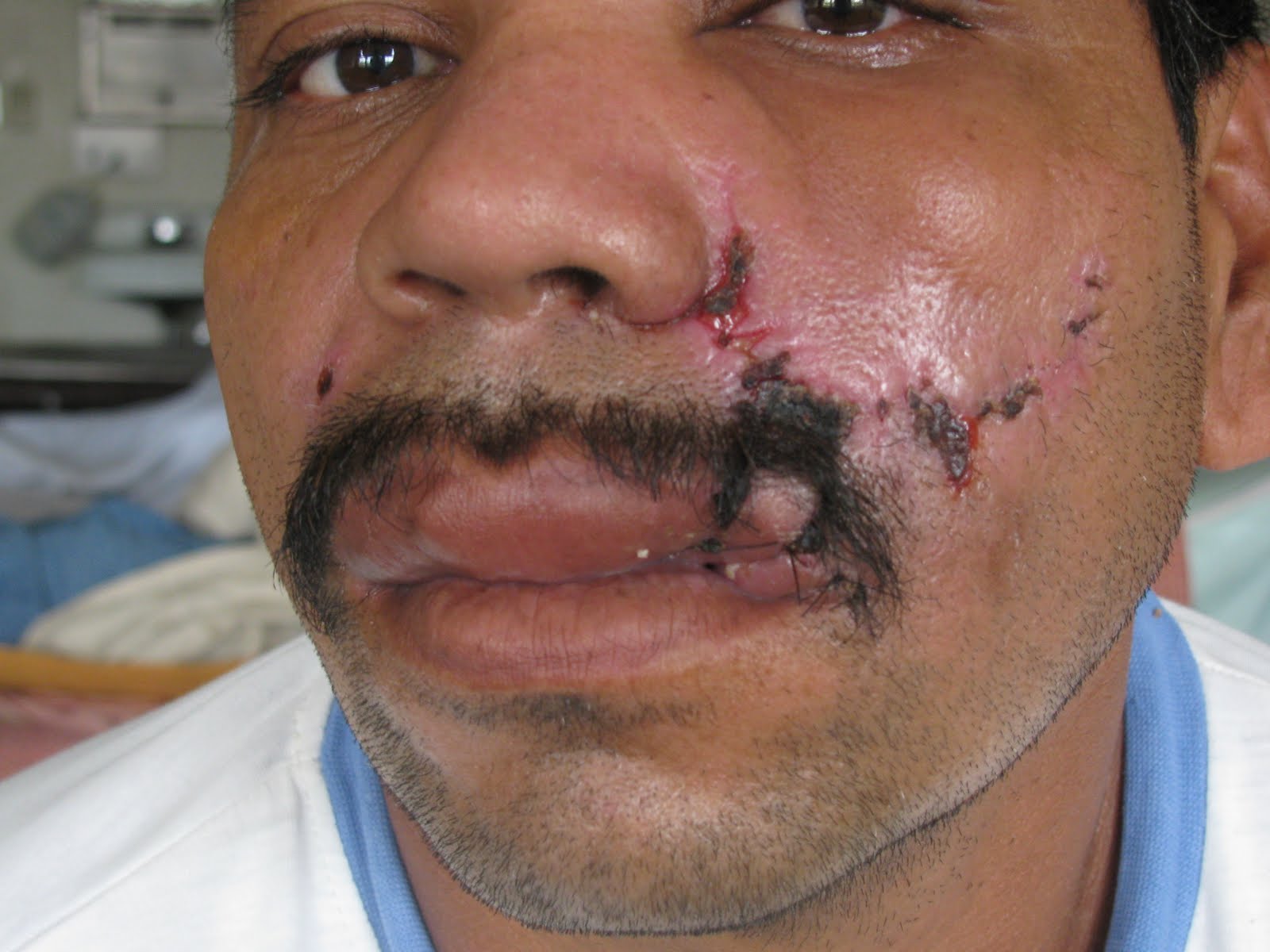
Julian from the community of Guadalupe Carney and one of the four MCA campesinos injured was shot in the head during the confrontation with Facusse's security guards. He remains in the hospital where he is awaiting an operation to reconstruct parts of his face.
A bullet entered in the right side of his face just below his cheek bone, passed through his upper lip area and exited on the left side of his face, fracturing his cheek bone. "The upper part of my mouth is destroyed. I can't eat, just liquids but not other types of good." Almost all of Julian's upper teeth and gums have been destroyed.
FUNDS ARE NEEDED:
The Campesino Movement of Aguan (MCA) and the families of the nine affected campesinos have many medical expenses and funeral costs.
TO MAKE TAX-DEDUCTIBLE DONATIONS
Make check payable to "Rights Action" and mail to:
UNITED STATES: Box 50887, Washington DC, 20091-0887
CANADA: 552 - 351 Queen St. E, Toronto ON, M5A-1T8
CREDIT-CARD DONATIONS: http://rightsaction.org/contributions.htm
DONATIONS OF STOCK: info@rightsaction.org
* * *
WORLD BANK-FUNDED BIOFUEL CORPORATION MASSACRES SIX HONDURAN CAMPESINOS
By Annie Bird, annie@rightsaction.org
MASSACRED WHILE WORKING THEIR FIELDS
Approximately six months ago, campesino farmers in Trujillo, Colon organized in the Campesino Movement of the Aguan, the MCA, were awarded provisional title to a farm which neighbors their community, as part of a long standing negotiation with Dinant Corporation, a biofuel company, whose land claims are illegitimate.
Since that time, the small farmers worked the land. In recent weeks they had noticed incursions into their land by armed security forces employed by the biofuel company, Dinant.
On Monday, November 15, the farmers went to their fields but were then attacked by Dinant security. Six were killed in the massacre and two more are in critical condition.
The massacre occurred the same day that the de facto Honduran president Pepe Lobo had planned to meet with the director of the US government development fund, the Millennium Challenge, in Denver to ask for funding for so called "renewable energy" - in Honduras, principally biofuels and dams.
WORLD BANK AND OTHER "DEVELOPMENT" GROUPS SHARE RESPONSIBILITY FOR THE MASSACRE
The "renewable energy" plan Lobo is shopping around may be the result of an Inter-American Development Bank (IADB) funded technical support grant (T-1101) to the de facto government ushered in after the June 28 military coup. In November 2009, under a coup government and amidst grave human rights violations, the World Bank's (WB) International Finance Corporation gave Dinant Corporation a $30 million loan for biofuel production, and now shares responsibility in the massacre.
Policies supposedly intended to stop climate change are in reality fueling climate change. The world must invest in a renewable way of life, not destructive "renewable energy". Scientists have analyzed that biofuel industry together with the climate change prevention mechanisms currently promoted could actually result in the destruction of half of the planets forests.
In the same way that massacres cannot be stopped when justice systems are destroyed by military coups, the destruction of our planet cannot be stopped when the systems of governance have been hijacked by corporations who can buy off, or that failing, militarily intervene in nations attempting to build just forms of governance. Human rights and the environment cannot be separated.
US MILITARY BASE BOUGHT FOR AGRARIAN REFORM AND STOLEN FOR AGRIBUSINESS
During the past decade, campesinos in Honduras have challenged a series of illegitimate land titles obtained by agro-businessmen in a massive former US military training center known as the CREM.
On this land, over 5,000 hectares, the US military trained military forces from across Central America, particularly the Contra paramilitary forces attacking the Sandinista government in Nicaragua. Once the CREM center's operations ended, the Honduran government bought the land from a US citizen through the Honduran land reform program.
However, instead of being sold to small farmers, as the government was obligated by law to do, the land was illegally divided up between several large landholders as a result of corruption and fraudulent titling processes. A coalition of land rights organizations in Honduras organized in the Campesino Movement of the Aguan, the MCA, to challenge the illegal titles. Little by little the land titles were awarded to groups of campesinos organized in the MCA.
The titling process has been slow and marked by violent attacks by the large landholders who have influence in the government, police and military forces. Among the last of the CREM lands to remain in the hands of agribusiness interests is the farm called El Tumbador, approximately 700 hectares controlled by the Dinant Corporation, property of Honduras' most powerful agro-businessman, Miguel Facusse.
A biofuel businessman with interests in several corporations, Miguel Facusse is infamous for the use of fraudulent methods, including intimidation and violence, to obtain lands throughout the country.
THE WORLD BANK BACKS THE CORRUPT AND VIOLENT DINANT CORPORATION
Since the military coup in June 2009, Honduras has been ruled by illegitimate, repressive regimes.
In November 2009, the WB extended a loan of $30 million to Dinant for its biofuel production in that region, despite a widely documented history of violence and corruption by the biofuel company. The WB failed in its human rights obligations in this case and shares responsibility for this massacre.
Given the conditions in Honduras, the WB must suspend both private and public sector funding to Honduras, and freeze funding of biofuels in the region. The biofuel industry in Central and South America violently displaces small farmers and contributes to global warming.
Another multinational public fund that finances international private investment, the Interamerican Investment Corporation, has also recently funded Dinant.
"GREENWASHING" AND CORPORATE WELFARE - THE HIJACKING OF CLIMATE CHANGE FUNDS
Biofuels are one of the fastest growing industries, a sector that sees high levels of investment from venture capitalists. This massive growth has been stimulated by taxpayer dollars pouring into renewable energy through many funding agencies, but particularly the IADB, the WB, and carbon emissions trading markets.
The trade in carbon credits was created as an element of the Kyoto Protocol, signed in 1997. It attempts to implement a market based system to curb global warming by levying penalties against heavy polluting industries that produce high levels of greenhouse gas emissions, such as carbon burning energy generation plants. But those penalties can be paid off, or offset, by the purchase of carbon credits.
Carbon credits are given to industries that undertake activities that reduce emission of gases that generate climate change, and those can then be sold on the market to companies that generate global warming.
The system is riddled with problems, beginning with the fact that the big money to be made in "green" industry creates a big incentive to greenwash, to disguise polluting activities as activities that do not pollute in order to cash in on climate change funds.
This is the case with biofuels.
BIOFUELS COULD DESTROY HALF THE WORLD'S FORESTS
Even as governments pour taxpayer money into biofuels, it is being demonstrated that biofuel production contributes significantly to global warming, through the destruction of wetlands, displacement of small farmers and food production, often to cut forests, direct clear cutting of forests for biofuel production, and even cutting forests to generate wood pellets that make ethanol.
One study published in Science magazine in October 2009 analyzed regulation set up in the Kyoto Accords which promotes the use of biofuels, but finds that these measures could result in the loss of up to half of the world's forests.
As the negative impacts were beginning to be felt, though the extent is only beginning to be understood, the World Wildlife Fund (WWF), and others committed to market incentives for polluters, set up the Round Table on Sustainable Palm Oil.
This body certifies palm oil as having been 'sustainably' produced. In May 2010, WWF signed an agreement with Miguel Facusse's Dinant Corporation to begin the process of certifying Dinant palm oil. The WB, in November 2009, shortly after disbursing Dinant's loan, froze palm oil funding while it created its palm oil strategy, expected to be completed in March 2011.
US CORPORATIONS COULD MAKE $27 TRILLION OFF "LESSER DEVELOPED COUNTRIES" CONVERSION TO BIOFUELS
By the time these impacts were being seen, big corporations, with their lobbies, were drooling over the potential profits. The WWF is strongly committed to paying off big business to reduce emissions. A recent WWF study urges taxpayer money be poured into renewable energy in "lesser developed countries" (LDCs) in order to stimulate job growth in the United States.
Governments are committing to insuring that a certain percentage of fuel consumption be converted to biofuel consumption around the world but especially in "LDCs." This will generate a huge market for technology to convert engines and other existing infrastructure, which according to WWF could represent a $27 trillion dollar market for US corporations.
Faced with the powerful corporate lobby corrupting and pressuring governments around the globe, and sometimes promoting military interventions to back their interests, changing policies to really fight climate change as opposed to subsidizing corporations seems a quixotic dream, as was seen in the failed summit on climate change in Copenhagen last year.
At the 16th international summit on climate change in Copenhagan, nations agreed to set up an, as yet, unclear mechanism called the REDD+ (Reducing Emissions from Deforestation and Degradation), which would focus on curbing deforestation. Paradoxically, incentives for forest preservation are still banned, and the potential for biofuel stimulated deforestation of half of the world's forests is still not addressed.
It is important to remember that the WWF and others who believe in and promote environmental market economics have promoted a system of biosphere privatization which allows degrading activities to be carried out by private companies that subsidize non-governmental organizations that manage the biospheres, while ignoring the rights of campesino communities and indigenous peoples.
GOVERNMENTS SHOULD INVEST IN THE POOR, NOT IN THE SUPER RICH
The international community's failure to substantively address climate change is a result the unwillingness to acknowledge and name the economic and political policies and actors that are responsible for climate harm.
The "free" market cannot correct the damage it has done, further investing in the same actors and under the same policy framework that generated climate change cannot reverse it.
To reverse climate change, the wealthiest nations and people of the world must change how they live. Indigenous and campesino communities have more sustainable ways of life, have learned to live in a sustainable way with the resources they produce. But they are being displaced and massacred to usher in the concentration of land and wealth, the genocide of a sustainable way of life.
Rather than subsidizing corporate mass destruction, the nations of the world must invest in a different way of life, and hold accountable those that destroy human life and destroy our only and irreplaceable, planet.
(Annie Bird is co-director of Rights Action, annie@rightsaction.org, www.rightsaction.org. Feel free to re-publish this article, citing author & source)
* * *
WHAT TO DO
Even as Honduras has been suspended from the Organization of American States, even as most Latin American governments refuse to recognize the legitimacy of the illegitimate and repressive regime in place in Honduras, the governments of the US and Canada are working the hardest to support and legitimize this very regime.
Rights Action asks that Americans and Canadians continue to send this, and other information, to your own senators, congress members and parliamentarians, insisting that they do every thing they can to ensure that the US and Canada suspend military and economic relations with the Honduran regime and demand full legal accountability for the massacre of these 6 campesinos in Aguan and all cases of State sponsored or tolerated repression.
* * *
SPEAKERS: Contact us to plan educational presentations in your community, school, place of worship, home (info@rightsaction.org)
EDUCATIONAL DELEGATIONS TO CENTRAL AMERICA: Form your own group and/ or join one of our educational delegation-seminars to learn first hand about community development, human rights and environmental struggles (info@rightsaction.org)
* CREATE YOUR OWN email and mail lists and re-distribute our information
* RECOMMENDED DAILY NEWS: www.democracynow.org / www.upsidedownworld.org / www.dominionpaper.ca
* RECOMMENDED BOOKS: Eduardo Galeano's "Open Veins of Latin America"; Howard Zinn's "A People's History of the United States"; James Loewen's "Lies My Teacher Told Me"; Naomi Klein's "The Shock Doctrine"; Paolo Freire's "Pedagogy of the Oppressed"; Dr Seuss's "Horton Hears A Who"
FOR MORE INFORMATION: Grahame Russell, info@rightsaction.org, Annie Bird, annie@rightsaction.org, Karen Spring (in Honduras), spring.kj@gmail.com
= = =
ANNOUNCEMENT OF LAWSUIT AGAINST MAJOR CANADIAN MINING COMPANY RELATING TO MURDER OF MAYAN LEADER IN LATIN AMERICA

Toronto, November 29, 2010: On Wednesday December 1, 2010 at 10:30am, lawyers for the widow of a community leader who was shot and hacked to death in an unprovoked attack by private security forces employed at a Canadian mining project in Latin America will announce a lawsuit brought in Ontario courts against a major Canadian mining company.
The murdered man was an outspoken critic of harms caused by Canadian mining activities in his community. To date, no one has been held accountable for his death.
This press announcement comes one month after Parliament voted against Bill C-300, a bill intended to ensure that Canadian mining companies operating abroad act in accordance with Canada’s commitments to international human rights standards.
Other participants will include:
The Honourable Peter Julian: Member of Parliament and author of Bill C-354: legislation which seeks to protect foreign citizens against serious human rights abuses committed by Canadian corporations operating outside of Canada.
Professor Craig Scott: Director of the Nathanson Centre on Transnational Human Rights, Crime and Security, and Professor at Osgoode Hall Law School.
Grahame Russell: Co-director of Rights Action, a non-profit organization that works in close proximity with community groups in Honduras, Guatemala, El Salvador and Mexico.
WHEN:
Wednesday, December 1, 2010
10:30am
WHERE:
Suite 400, 4th Floor “Innovation Lab”
215 Spadina Avenue
Toronto, Ontario
CONTACT:
For details as to time and location only:
Murray Klippenstein, Legal Counsel, 416-937-8634 (mobile)
Silas Polkinghorne, 416-799-5365 (mobile)
For more information see www.chocversushudbay.com, after 10:30 a.m., Dec. 1.
Monday, August 30, 2010
Repression in Honduras continues, unabated
Last Thursday and Friday, police and military violently repressed public school teachers that have taken to the streets for almost 3 weeks to demand, amongst other things, that the Pepe Lobo government return 4 billion lempiras (or 40 million dollars) that were taken from IMPREMA, an institution that manages teacher’s pension funds, after the military coup against President Zelaya on June 28, 2009.
The 6 teachers unions that form under the umbrella organization, Federation of Teacher’s Organizations of Honduras (FOMH by its spanish acronym) that represents 63,000 teachers nation-wide believe that the funds taken from this institution were used to fund the military machine run by the oligarchy, illegal President Micheletti and head of the armed forces, Romeo Vasquez Velasquez to repress and terrorize the pro-democracy movement critical of the coup and it’s perpetrators.
The education system in Honduras has been in crisis for the last 4 months particularly the month of August starting when the university students occupied the National Autonomous University (UNAH, Spanish acronym) demanding the reinstatement of 180 workers fired from their positions and the resignation of university director, Julieta Castrellano. Five fired workers still remain on hunger strike on the university grounds, some now reaching over 126 days without eating.
During the university occupation, police showed up during the occupation and attempted to enter the university where they were then run off university grounds by the protesters. The stand off between the students and police occurred at the time that State Department's Maria Otero was visiting Honduras to investigate the human rights situation, an attempt once again by the United States government to paint the picture that the Lobo government is working hard to better the human rights situation in the country, a necessary condition to having Honduras readmitted into the Organiation of American States (OAS).

In front of occupied National Autonomous University (UNAH, its spanish acronym) by students & supporting members of the national resistance movement. White sign reads 'Maria Otero, go home'
Although the university student and the public school teachers have different immediate focuses and demands, they both claim that the form in which the Pepe Lobo’s government is managing the teacher’s struggle and education system in general is one of the many attempts by the oligarchy and the government to privatize the public education system in Honduras.
Recognizing this threat, this massive teachers strike converges and compliments that on-going struggle of the National Front of Popular Resistance (FNRP) as well as the preparatory stages of a mass general strike involving the three major umbrella unions (Unitary Confederacy of Workers of Honduras (CUTH, by its Spanish acronym); the Confederacy of Workers of Honduras (CTH, Spanish acronym); the General Head office of Workers (CGT, Spanish acronym) to which all unionized Honduran workers are apart.
3 DAYS OF BARBARIC REPRESSION AGAINST THE TEACHERS
Last Friday, August 27th, teachers were violently evicted twice from the area around the National Pedagogical University first when they had occupied the boulevard and second, when teachers were regrouping and meeting inside the University.
At the University, located close to a major boulevard and across from a business shopping centre, police arrived with 2 water tanks, firing more than a 100 tear gas canisters and rubber bullets at the teachers and members of the resistance movement in and outside the university grounds, beating up those they chased and captured without regard for the presence of children and the public in the busy area of the city and the peaceful form in which the teachers were protesting.

August 27, 2010. In front of National Pedological University, police show up firing tear gas to evict teachers.
From a black Toyota four-runner parked on the street in front of the University, a man opened fired at the protesters with a 9-millimeter gun. Although no one was shot, the car was later identified as belonging to the National Congress.
Over 100 people were captured and ‘guarded’ by police against a fence outside the University. They were later released after human rights representatives arrived and negotiated with the police. Many teachers and resistance members, fleeing the tear gas were trapped inside the classrooms in the university where they suffered from severe exposure to tear gas. Over 7 people were injured from the gas and from police beatings including a journalist from Globo TV/Radio Globo.

Police 'guarding' teachers and individuals they captured during violent eviction.
The day before, on Thursday, after occupying a street close to the Presidential Palace in Tegucigalpa, police and military violently evicted the teachers. Six teachers were reported injured from the tear gas and wounds inflicted by the police.
These two days last week were the icing on the cake to the violence inflicted against the teachers movement on August 20th, when again, police/military evicted the movement and brutally beat up 3 union leaders and one teacher that all were supposedly identified on the spot to the police by individuals infiltrated in the marches.
Before and particularly since August 20th, the major media outlets owned by the oligarchy continue a media campaign against the teacher’s movement to portray them as instruments of violence with no regard for children’s education and the educational system in Honduras.
At the writing of this article, the teachers are gathered in their daily assembly to discuss an agreement recently negotiated between the Government negotiation team and the leaders of the teacher’s movement. Today, the teachers will announce whether they accept the proposal or not.
The 6 teachers unions that form under the umbrella organization, Federation of Teacher’s Organizations of Honduras (FOMH by its spanish acronym) that represents 63,000 teachers nation-wide believe that the funds taken from this institution were used to fund the military machine run by the oligarchy, illegal President Micheletti and head of the armed forces, Romeo Vasquez Velasquez to repress and terrorize the pro-democracy movement critical of the coup and it’s perpetrators.
The education system in Honduras has been in crisis for the last 4 months particularly the month of August starting when the university students occupied the National Autonomous University (UNAH, Spanish acronym) demanding the reinstatement of 180 workers fired from their positions and the resignation of university director, Julieta Castrellano. Five fired workers still remain on hunger strike on the university grounds, some now reaching over 126 days without eating.
During the university occupation, police showed up during the occupation and attempted to enter the university where they were then run off university grounds by the protesters. The stand off between the students and police occurred at the time that State Department's Maria Otero was visiting Honduras to investigate the human rights situation, an attempt once again by the United States government to paint the picture that the Lobo government is working hard to better the human rights situation in the country, a necessary condition to having Honduras readmitted into the Organiation of American States (OAS).

In front of occupied National Autonomous University (UNAH, its spanish acronym) by students & supporting members of the national resistance movement. White sign reads 'Maria Otero, go home'
Although the university student and the public school teachers have different immediate focuses and demands, they both claim that the form in which the Pepe Lobo’s government is managing the teacher’s struggle and education system in general is one of the many attempts by the oligarchy and the government to privatize the public education system in Honduras.
Recognizing this threat, this massive teachers strike converges and compliments that on-going struggle of the National Front of Popular Resistance (FNRP) as well as the preparatory stages of a mass general strike involving the three major umbrella unions (Unitary Confederacy of Workers of Honduras (CUTH, by its Spanish acronym); the Confederacy of Workers of Honduras (CTH, Spanish acronym); the General Head office of Workers (CGT, Spanish acronym) to which all unionized Honduran workers are apart.
3 DAYS OF BARBARIC REPRESSION AGAINST THE TEACHERS
Last Friday, August 27th, teachers were violently evicted twice from the area around the National Pedagogical University first when they had occupied the boulevard and second, when teachers were regrouping and meeting inside the University.
At the University, located close to a major boulevard and across from a business shopping centre, police arrived with 2 water tanks, firing more than a 100 tear gas canisters and rubber bullets at the teachers and members of the resistance movement in and outside the university grounds, beating up those they chased and captured without regard for the presence of children and the public in the busy area of the city and the peaceful form in which the teachers were protesting.

August 27, 2010. In front of National Pedological University, police show up firing tear gas to evict teachers.
From a black Toyota four-runner parked on the street in front of the University, a man opened fired at the protesters with a 9-millimeter gun. Although no one was shot, the car was later identified as belonging to the National Congress.
Over 100 people were captured and ‘guarded’ by police against a fence outside the University. They were later released after human rights representatives arrived and negotiated with the police. Many teachers and resistance members, fleeing the tear gas were trapped inside the classrooms in the university where they suffered from severe exposure to tear gas. Over 7 people were injured from the gas and from police beatings including a journalist from Globo TV/Radio Globo.

Police 'guarding' teachers and individuals they captured during violent eviction.
The day before, on Thursday, after occupying a street close to the Presidential Palace in Tegucigalpa, police and military violently evicted the teachers. Six teachers were reported injured from the tear gas and wounds inflicted by the police.
These two days last week were the icing on the cake to the violence inflicted against the teachers movement on August 20th, when again, police/military evicted the movement and brutally beat up 3 union leaders and one teacher that all were supposedly identified on the spot to the police by individuals infiltrated in the marches.
Before and particularly since August 20th, the major media outlets owned by the oligarchy continue a media campaign against the teacher’s movement to portray them as instruments of violence with no regard for children’s education and the educational system in Honduras.
At the writing of this article, the teachers are gathered in their daily assembly to discuss an agreement recently negotiated between the Government negotiation team and the leaders of the teacher’s movement. Today, the teachers will announce whether they accept the proposal or not.
Thursday, July 29, 2010
1ST ANNIVERSARY OF THE MILITARY-OLIGARCHIC COUP IN HONDURAS: REPRESSION CONTINUES; RESISTANCE CONTINUES
FIRST ANNIVERSARY OF THE MILITARY-OLIGARCHIC COUP IN HONDURAS:
REPRESSION CONTINUES; RESISTANCE CONTINUES
"I was asking the police for a doctor because I felt like my skin was on fire and I could barely breath but they [the police] just laughed at me. They kept putting the tazer gun to my ear asking if I wanted to feel the shock again. It sent shivers through my entire body thinking about how it would feel." - Edwin Espinal
BELOW:
Illegal detention & torture of Edwin Robelo Espinal
Illegal detention of Berta Caceres, co-leader of COPINH
FOR INTERVIEWS & MORE INFORMATION:
Annie Bird, 1-202-680-3002 (annie@rightsaction.org)
Karen Spring, 011-504-9507-3835 (spring.kj@gmail.com)
WHAT TO DO: see below
* * *
THE 13TH ILLEGAL DETENTION OF EDWIN ESPINAL
By Karen Spring, Rights Action (in Honduras), July 10, 2010
Two days after the one-year anniversary of the resistance movement in Honduras, an active member of the movement, Edwin Robelo Espinal was detained and tortured in his neighbood, Flor del Campo, in Tegucigalpa.
Since the coup on June 28th 2009, Edwin has been in the streets participating in the pro-democracy movement and various activities of the resistance movement. He was accompanied by his partner, Wendy Elizabeth Avila until September 26th of last year when she was killed by tear gas shot at protesters in front of the Brazilian Embassy by police and military forces.
For full story on Wendy's death see the Fault Lines documentary: "100 days of Resistance"
Part 1: http://www.youtube.com/watch?v=EYY4vj9ROC0
Part II: http://www.youtube.com/watch?v=upMu_oR2YUU&feature=channel
Since the coup, Edwin has been subject to various forms of psychological and physical intimidation and harassment from the police and military. He has been illegally detained more than 12 times, beaten up, shot at and pulled over by police without reason or cause ... and the intimidation that has continued since then is another instance of him being targeted for his strong participation in the pro-democracy movement.
* * *
"I was asking the police for a doctor because I felt like my skin was on fire and I could barely breath but they [the police] just laughed at me. They kept putting the tazer gun to my ear asking if I wanted to feel the shock again. It sent shivers through my entire body thinking about how it would feel." - Edwin Espinal
* * *
On the night of Wednesday, June 30th, as Edwin was standing on the side of the road next to his car chatting with friends in his neighbourhood, a police patrol with 5 police officers pulled over and began to harass Edwin asking for his license. Having not committed any driving offence (as he was standing on the road), the officers began harassing him telling him they were going to arrest him.
The 5 officers began pushing and hitting Edwin with their batons trying to force him into the back of their pick up truck. When unable to, the head officer named Vargas by the label on his uniform, pulled out pepper spray and holding the spray roughly 10cm from his face, sprayed Edwin all over his face, hands and exposed skin.
Totally blinded, beaten up and choking on the large amount of gas that had entered his mouth, he was forced into the back of the pick up truck and driven for 20 minutes to an unknown location.
The pick up truck was parked and Edwin was left lying in the back. In the 15 minutes the truck was parked, the police continued to harass and torture him. One officer fired the tazer gun close to his ear and asked Edwin if he knew what it was. After responding, no, Edwin was shocked in the stomach. His capturers took various pictures of him and asking him questions like why he was a Zelayista [supporter of overthrown President Zelaya], for how long has he been in the resistance movement, why he's a communist, etc.
Edwin was then taken to the 4th police station in Comeyaguela, still blinded by the gas and unaware of where he was. After entering the police station and unable to breath, see or handle the extreme burning feeling of his face, neck and arms, Edwin begged the officers to get him a doctor. The police laughed at him. He was then shocked again by a tazer gun where he fell to the floor convulsing and shaking.
He was then put into a jail cell and held over night until representatives from COFADEH (Committee of the Families of the Detained and Disappeared in Honduras) arrived at the police station at 9:00 am to get him released.
* * *
"The first thing that they [the police] did to him [Edwin] was throw gas on him to detain him. This is a form of psychological and physical torture as it was gas that killed his wife, Wendy, months earlier." - Berta Oliva, COFADEH
* * *
Edwin's strong participation in the resistance movement makes him a strong target of repression. "The police in my neighbourhood hate me. They know my truck and they know that I'm in the resistance movement."
Another reason Edwin believes he is targeted by the handful of police that patrol his neighbourhood is because he was the witness of the murder of Francisco Alvarado, a man killed in Edwin's neighbourhood on September 22, 2009 when various residents were on the street protesting after being evicted from the Brazilian Embassy.
"The police in my neighbourhood know that I know that they killed Francisco Alvarado that night. After he was shot, we were trying to take him to the hospital but they wouldn't let us. We were scared that if they [the police] took him that they would kill him on the way to the hospital."
The complexities of Edwin's case do not stop there. The same police that tortured him on June 30th continue to patrol his neighbourhood and he is forced to see them almost everyday close to his home.
Today, July 7, Edwin saw a few of the police officers from his neighbourhood at the grocery store. After leaving the store, one hour later and arriving at his house, 2 police officers, one of them in uniform (the same one he saw at the grocery store) and another in civilian clothes, were waiting at the entrance to the drive way that leads up to his house.
The officer in civilian clothes, Edwin recognized as Vargas, the same officer that had sprayed pepper spray in his face, detained him and participated in torturing him a week earlier. Upon seeing Edwin's car, Vargas waved and smiled at Edwin and then both officers hopped on a motorcycle and drove away.
To Edwin, the message was clear, 'We are watching you.' Both officers had known he would be arriving home shortly, had left the grocery store and had waited for him to arrive at his house.
* * * * * * *
WHAT TO DO
COFADEH has made a formal complaint regarding Edwin's case to the Public Prosecutor's Office and urges the national and international community to contact the individuals below and:
Demand that the Honduran authorities guarantee the safety of Edwin Robelo Espinal to carry out a prompt, thorough and impartial investigation into the acts of intimidation, illegal arrests and torture that violate fundamental human rights of Edwin Robelo, to make public the results and bring those responsible for these acts to justice.
Ensure the safety of all people exercising their right to association and free expression.
Direct their communications to the following Honduran authorities:
Jorge Alberto Rivera Avilés
Presidente de la Corte Suprema de Justicia
Tel (504) 269-3000, 269-3069
cedij@poderjudicial.gob.hn
Luis Alberto Rubí
Fiscal General de la República.
Fax (504) 221-5667
Tel (504) 221-5670 221-3099
lrubi@mp.hn, suazog@mp.hn
Comité de Familiares de Detenidos Desaparecidos en Honduras, COFADEH
Barrio La Plazuela, Ave. Cervantes, Casa No. 1301. Apdo. Postal No. 1243, Tegucigalpa, M.D.C.
Tel/Fax (504) 220-5280 / 220-7147, cofadeh@sdnhon.org.hn, www.cofadeh.org
* * * * * * *
BERTHA CACERES DENOUNCES ABUSE OF AUTHORITY AND ILEGAL DETENTION
COPINH is a human rights organization whose activists have received countless threats and harassment following the 2009 coup in Honduras. The following denunciation is presented within this context:
Román Castro and Bertha Cáceres, members of COPINH were illegally and arbitrarily detained on 27 June 2010. In Bertha's case, the following occurred:
Following a phone call received about the organization of the 28 June activities -- the anniversary of the oligarchic-military coup -- and Mr. Castro's detention, COPINH's General Coordinator Bertha Cáceres was on her way to the Utopía Center. This center is located near the police station on the road from La Esperanza to Siguatepeque. Upon seeing COPINH's car at the station, she stopped.
She got out and introduced herself as a member of the COPINH directorate to the police officer in charge, Inspector Velásquez. When she asked why the car and its occupants had been detained, he responded that surely they had been stealing.
She then responded that it was a very serious accusation he was making and that he could not do that without proof. The inspector responded that he could do whatever he wanted. Bertha told him that this was illegal. She then stated that she had been notified that they had taken away 400 "sovereign declarations" from her companions and demanded their return. She also stated that the Army and the corrupt and repressive Police were going to be abolished with the new Constitution.
Inspector Velásquez became violent and ordered Bertha´s detention. When she responded that there was no reason for this, he again told her that he could do whatever he wanted. At that moment, he attacked Bertha, grabbing her arm and hitting her on the back. Then he told the other police officers, about 15 others were present, that they take her away because otherwise he was going to badly beat her.
The police put her into the patrol car and brought her to the police station. Once there they did not read her rights to her nor did they present any formal accusation against her. She was, however, detained for a few hours. When Commissioner Fuentes arrived, he stated that he was sorry for the action against her and that the best thing would be to sign a legal document (acta). Since there was no reason for this, Bertha refused. They released her. Upon which, she explained that there was another detained companion and solicited his release.
Both were released.
The 400 sovereign declarations were returned. On June 29, 2010 Bertha Cáceres, as COPINH's General Coordinator, presented a denunciation to the before the Attorney General´s Office against Inspector Velásquez and Preventive Police agents for the crime of abuse of authority and illegal detention.
It is very important to mention that the Inter American Commission on Human Rights has granted protective measures to Bertha Cáceres and all the COPINH activists.
Intibucá- Honduras, 29 June 2010
= = =
WHAT TO DO
FUNDS ARE NEEDED:
Since the coup, June 28, 2009, Rights Action has sent over $100,000 to community based Honduran organizations doing a range of work: community development education and organizing; human rights defense and promotion; media (radio, publications and internet); human rights accompaniment; reporting; emergency support for victims or repression and human rights violations; transportation; communication (phone, internet); camera work (film and still); travel to forums and negotiations; etc..
TAX DEDUCTIBLE DONATIONS
To support the Honduras pro-community development, pro-democracy, anti-military coup movement and to support the real Truth Commission, make check payable to "Rights Action" and mail to:
UNITED STATES: Box 50887, Washington DC, 20091-0887
CANADA: 552 - 351 Queen St. E, Toronto ON, M5A0in8
CREDIT-CARD DONATIONS: http://rightsaction.org/contributions.htm
* * *
REPRESSION CONTINUES; RESISTANCE CONTINUES
"I was asking the police for a doctor because I felt like my skin was on fire and I could barely breath but they [the police] just laughed at me. They kept putting the tazer gun to my ear asking if I wanted to feel the shock again. It sent shivers through my entire body thinking about how it would feel." - Edwin Espinal
BELOW:
Illegal detention & torture of Edwin Robelo Espinal
Illegal detention of Berta Caceres, co-leader of COPINH
FOR INTERVIEWS & MORE INFORMATION:
Annie Bird, 1-202-680-3002 (annie@rightsaction.org)
Karen Spring, 011-504-9507-3835 (spring.kj@gmail.com)
WHAT TO DO: see below
* * *
THE 13TH ILLEGAL DETENTION OF EDWIN ESPINAL
By Karen Spring, Rights Action (in Honduras), July 10, 2010
Two days after the one-year anniversary of the resistance movement in Honduras, an active member of the movement, Edwin Robelo Espinal was detained and tortured in his neighbood, Flor del Campo, in Tegucigalpa.
Since the coup on June 28th 2009, Edwin has been in the streets participating in the pro-democracy movement and various activities of the resistance movement. He was accompanied by his partner, Wendy Elizabeth Avila until September 26th of last year when she was killed by tear gas shot at protesters in front of the Brazilian Embassy by police and military forces.
For full story on Wendy's death see the Fault Lines documentary: "100 days of Resistance"
Part 1: http://www.youtube.com/watch?v=EYY4vj9ROC0
Part II: http://www.youtube.com/watch?v=upMu_oR2YUU&feature=channel
Since the coup, Edwin has been subject to various forms of psychological and physical intimidation and harassment from the police and military. He has been illegally detained more than 12 times, beaten up, shot at and pulled over by police without reason or cause ... and the intimidation that has continued since then is another instance of him being targeted for his strong participation in the pro-democracy movement.
* * *
"I was asking the police for a doctor because I felt like my skin was on fire and I could barely breath but they [the police] just laughed at me. They kept putting the tazer gun to my ear asking if I wanted to feel the shock again. It sent shivers through my entire body thinking about how it would feel." - Edwin Espinal
* * *
On the night of Wednesday, June 30th, as Edwin was standing on the side of the road next to his car chatting with friends in his neighbourhood, a police patrol with 5 police officers pulled over and began to harass Edwin asking for his license. Having not committed any driving offence (as he was standing on the road), the officers began harassing him telling him they were going to arrest him.
The 5 officers began pushing and hitting Edwin with their batons trying to force him into the back of their pick up truck. When unable to, the head officer named Vargas by the label on his uniform, pulled out pepper spray and holding the spray roughly 10cm from his face, sprayed Edwin all over his face, hands and exposed skin.
Totally blinded, beaten up and choking on the large amount of gas that had entered his mouth, he was forced into the back of the pick up truck and driven for 20 minutes to an unknown location.
The pick up truck was parked and Edwin was left lying in the back. In the 15 minutes the truck was parked, the police continued to harass and torture him. One officer fired the tazer gun close to his ear and asked Edwin if he knew what it was. After responding, no, Edwin was shocked in the stomach. His capturers took various pictures of him and asking him questions like why he was a Zelayista [supporter of overthrown President Zelaya], for how long has he been in the resistance movement, why he's a communist, etc.
Edwin was then taken to the 4th police station in Comeyaguela, still blinded by the gas and unaware of where he was. After entering the police station and unable to breath, see or handle the extreme burning feeling of his face, neck and arms, Edwin begged the officers to get him a doctor. The police laughed at him. He was then shocked again by a tazer gun where he fell to the floor convulsing and shaking.
He was then put into a jail cell and held over night until representatives from COFADEH (Committee of the Families of the Detained and Disappeared in Honduras) arrived at the police station at 9:00 am to get him released.
* * *
"The first thing that they [the police] did to him [Edwin] was throw gas on him to detain him. This is a form of psychological and physical torture as it was gas that killed his wife, Wendy, months earlier." - Berta Oliva, COFADEH
* * *
Edwin's strong participation in the resistance movement makes him a strong target of repression. "The police in my neighbourhood hate me. They know my truck and they know that I'm in the resistance movement."
Another reason Edwin believes he is targeted by the handful of police that patrol his neighbourhood is because he was the witness of the murder of Francisco Alvarado, a man killed in Edwin's neighbourhood on September 22, 2009 when various residents were on the street protesting after being evicted from the Brazilian Embassy.
"The police in my neighbourhood know that I know that they killed Francisco Alvarado that night. After he was shot, we were trying to take him to the hospital but they wouldn't let us. We were scared that if they [the police] took him that they would kill him on the way to the hospital."
The complexities of Edwin's case do not stop there. The same police that tortured him on June 30th continue to patrol his neighbourhood and he is forced to see them almost everyday close to his home.
Today, July 7, Edwin saw a few of the police officers from his neighbourhood at the grocery store. After leaving the store, one hour later and arriving at his house, 2 police officers, one of them in uniform (the same one he saw at the grocery store) and another in civilian clothes, were waiting at the entrance to the drive way that leads up to his house.
The officer in civilian clothes, Edwin recognized as Vargas, the same officer that had sprayed pepper spray in his face, detained him and participated in torturing him a week earlier. Upon seeing Edwin's car, Vargas waved and smiled at Edwin and then both officers hopped on a motorcycle and drove away.
To Edwin, the message was clear, 'We are watching you.' Both officers had known he would be arriving home shortly, had left the grocery store and had waited for him to arrive at his house.
* * * * * * *
WHAT TO DO
COFADEH has made a formal complaint regarding Edwin's case to the Public Prosecutor's Office and urges the national and international community to contact the individuals below and:
Demand that the Honduran authorities guarantee the safety of Edwin Robelo Espinal to carry out a prompt, thorough and impartial investigation into the acts of intimidation, illegal arrests and torture that violate fundamental human rights of Edwin Robelo, to make public the results and bring those responsible for these acts to justice.
Ensure the safety of all people exercising their right to association and free expression.
Direct their communications to the following Honduran authorities:
Jorge Alberto Rivera Avilés
Presidente de la Corte Suprema de Justicia
Tel (504) 269-3000, 269-3069
cedij@poderjudicial.gob.hn
Luis Alberto Rubí
Fiscal General de la República.
Fax (504) 221-5667
Tel (504) 221-5670 221-3099
lrubi@mp.hn, suazog@mp.hn
Comité de Familiares de Detenidos Desaparecidos en Honduras, COFADEH
Barrio La Plazuela, Ave. Cervantes, Casa No. 1301. Apdo. Postal No. 1243, Tegucigalpa, M.D.C.
Tel/Fax (504) 220-5280 / 220-7147, cofadeh@sdnhon.org.hn, www.cofadeh.org
* * * * * * *
BERTHA CACERES DENOUNCES ABUSE OF AUTHORITY AND ILEGAL DETENTION
COPINH is a human rights organization whose activists have received countless threats and harassment following the 2009 coup in Honduras. The following denunciation is presented within this context:
Román Castro and Bertha Cáceres, members of COPINH were illegally and arbitrarily detained on 27 June 2010. In Bertha's case, the following occurred:
Following a phone call received about the organization of the 28 June activities -- the anniversary of the oligarchic-military coup -- and Mr. Castro's detention, COPINH's General Coordinator Bertha Cáceres was on her way to the Utopía Center. This center is located near the police station on the road from La Esperanza to Siguatepeque. Upon seeing COPINH's car at the station, she stopped.
She got out and introduced herself as a member of the COPINH directorate to the police officer in charge, Inspector Velásquez. When she asked why the car and its occupants had been detained, he responded that surely they had been stealing.
She then responded that it was a very serious accusation he was making and that he could not do that without proof. The inspector responded that he could do whatever he wanted. Bertha told him that this was illegal. She then stated that she had been notified that they had taken away 400 "sovereign declarations" from her companions and demanded their return. She also stated that the Army and the corrupt and repressive Police were going to be abolished with the new Constitution.
Inspector Velásquez became violent and ordered Bertha´s detention. When she responded that there was no reason for this, he again told her that he could do whatever he wanted. At that moment, he attacked Bertha, grabbing her arm and hitting her on the back. Then he told the other police officers, about 15 others were present, that they take her away because otherwise he was going to badly beat her.
The police put her into the patrol car and brought her to the police station. Once there they did not read her rights to her nor did they present any formal accusation against her. She was, however, detained for a few hours. When Commissioner Fuentes arrived, he stated that he was sorry for the action against her and that the best thing would be to sign a legal document (acta). Since there was no reason for this, Bertha refused. They released her. Upon which, she explained that there was another detained companion and solicited his release.
Both were released.
The 400 sovereign declarations were returned. On June 29, 2010 Bertha Cáceres, as COPINH's General Coordinator, presented a denunciation to the before the Attorney General´s Office against Inspector Velásquez and Preventive Police agents for the crime of abuse of authority and illegal detention.
It is very important to mention that the Inter American Commission on Human Rights has granted protective measures to Bertha Cáceres and all the COPINH activists.
Intibucá- Honduras, 29 June 2010
= = =
WHAT TO DO
FUNDS ARE NEEDED:
Since the coup, June 28, 2009, Rights Action has sent over $100,000 to community based Honduran organizations doing a range of work: community development education and organizing; human rights defense and promotion; media (radio, publications and internet); human rights accompaniment; reporting; emergency support for victims or repression and human rights violations; transportation; communication (phone, internet); camera work (film and still); travel to forums and negotiations; etc..
TAX DEDUCTIBLE DONATIONS
To support the Honduras pro-community development, pro-democracy, anti-military coup movement and to support the real Truth Commission, make check payable to "Rights Action" and mail to:
UNITED STATES: Box 50887, Washington DC, 20091-0887
CANADA: 552 - 351 Queen St. E, Toronto ON, M5A0in8
CREDIT-CARD DONATIONS: http://rightsaction.org/contributions.htm
* * *
Thursday, April 29, 2010
Threats Against Carlos Amador, Member of the Siria Valley Environmental Committee, Which has Opposed Goldcorp Gold Mining in Honduras Since 2000

The Goldcorp San Marlin mine from a distance in Siria Valley, Honduras
From May 7-22, Carlos Amador will be on a speaking tour in Ontario, Canada, as lead up to Goldcorp Inc’s Annual Shareholder Meeting, May 19th, in Toronto. Carlos will be speaking along with Javier de Leon, from the Goldcorp Inc affected communities in Guatemala, and Karen Spring of Rights Action.
* * * * * * *
THREATS AGAINST CARLOS AMADOR, MEMBER OF THE SIRIA VALLEY ENVIRONMENTAL COMMITTEE, WHICH HAS OPPOSED GOLDCORP GOLD MINING IN HONDURAS SINCE 2000
By Annie Bird and Karen Spring, April 29, 2010
On April 13, 2010, 15 armed police arrived at the middle school where Carlos Amador, a teacher and founding member of the Siria Valley Environmental Committee, works. They approached the school with guns raised in attack position.
When they were unable to find Carlos, the police next went to his house which they also approached with raised guns and interrogated his two minor daughters as to his whereabouts.
At his home, the police left a citation calling Carlos to meet with an investigator for the National Office of Criminal Investigation. Upon arriving at the meeting and in contrary to regular legal proceedings, the investigator took Carlos along with a lawyer from COFADEH, a human rights organization, to the district attorney’s office where he was questioned about the Committee’s work in the Siria Valley. These questions included, "who are the leaders of the committee", "where do they live", "when does the committee meet", etc.
These acts of intimidation against Carlos and his family occur at a time when death squad violence and repression by State security forces are being carried out across Honduras against those who have opposed the military coup.
While most members of the Committee support the coup resistance movement, the mining company (Goldcorp Inc’s subsidiary Entre Mares) shipped some workers and other locals on buses – giving them $20 cash each - to staged protests in favor of the June 28, 2009 military coup against the elected government of President Zelaya.
GOLDCORP ALLIES ATTEMPT ILLEGAL LOGGING, RESULTING IN ONE DEATH AND TWO INJURIES
This intimidation against Carlos Amador and Siria Valley Environmental Committee also occurred following a violent confrontation between security guards and five communities in the municipality of El Porvenir, which resulted in one death and two injured people.
On April 7th, armed security guards from a private security company reportedly owned by the Raudales Urrutia family attempted to bring in heavy machinery to conduct logging on a 600 hectare plot of land owned by the communities in El Porvenir.
Community members claim that the Raudales Urrutia family illegally obtained “title” to the land two years prior and, in fact, have no right to the land or the trees. These five communities hold land titles dating from the year 1800, and the communities have been soliciting that the Institute for Environmental Conservation declare the area a protected area. The forested hill sits between the five communities and is the source of drinking water for those communities.
The sub-soil mineral rights below this particular 600 hectare plot were conceded years before by the Honduran government, with no prior consultation with or consent from the local communities, to Goldcorp subsidiary Entre Mares, which has been trying to expand their gold mining operations in Siria Valley despite strong community resistance.
The close relationship the Raudales Urrutia family maintains with Goldcorp leads neighbors to believe the family will permit Goldcorp/ Entre Mares to expand their operations onto the plot.
“FAVOURABLE” CONDITIONS FOR CANADIAN INVESTORS
Just one day before the confrontation in Siria Valley, Canadian ambassador to Honduras, Neil Reeder, along with Patrick Downey (from Canadian mining company Aura Minerals Inc.) and investor David Petroff met with regime leader Pepe Lobo to express interest in increasing Canadian investments in the mining and textile sweatshop industries, amounting – the Canadians claimed - to $700 million in investments.
During their visit, no mention was made of the repressive political situation in Honduras or the illegitimacy of the Lobo government.
Armed aggression by paramilitaries and private security guards at the service of landholders with dubious legal rights over lands have increased dramatically across Honduras, fueled by favorable (and quite brutal) political conditions ushered in by the June 28, 2009 military coup.
These ‘favorable’ conditions continue under the presidency of Pepe Lobo. His regime is comprised almost entirely of the same people who planned and carried out the military coup.
All six military generals who spearheaded the coup were not only exonerated of criminal responsibility in a sham trial in January 2009, but continue to occupy key government positions.
OUSTED HONDURAN PRESIDENT STOOD UP TO MINING INTERESTS
Goldcorp, having completed exploitation of their first tract, the Palo Alto y Tajo la Rosa concession, is apparently anxious to begin exploitation of neighboring concessions, such as the area whose clear cutting spurred the conflict earlier this month.
Goldcorp Inc’s superficial and controversial closure plan was rejected by neighbors as it did not take adequate measures to cleanup the massive use of cyanide nor the dangerous presence of heavy metals, such as arsenic, lead and mercury, among others, which have been demonstrated to exceed internationally established standards in Siria Valley water systems, and in the bodies of the residents.
Goldcorp’s Closure Plan was not accepted by the administration of then President Manuel Zelaya, which in April 2009 created an inter-institutional commission to examine the plan and the impact of Goldcorp’s operations in the region.
On March 18, 2010, Goldcorp announced to the press that the Closure Plan had been approved, although authorization of the plan had not actually yet been obtained. Another hurdle faced by Goldcorp was a moratorium on new mining operations that the militarily ousted government of President Zelaya brought into force.
The moratorium was enacted through a presidential decree issued by the President Zelaya in 2007 which banned the exploitation of new mining concessions using certain techniques. A 2008 ruling by the Supreme Court supported the Presidential Decree, finding sections of the 1998 General Mining Law, that was approved by the corrupted Honduras Congress during a “state of emergency” following Hurricane Mitch, to be unconstitutional.
This highly unpopular 1998 mining law ushered in a fire sale of mining concessions. A new mining law is needed by mining companies to define the procedure they must follow to enter into exploitation of the concessions they hold.
On April 27, 2009 President Manuel Zelaya proposed a mining law that banned open pit mining and the use of certain chemicals, such as cyanide, in the refining process. This law would have made impossible any expansion plans by mining companies, such as Goldcorp.
In February 2010, the post-coup Congress began debating a new mining law.
IMPUNITY FAVORS MINERS WHILE ENVIRONMENTALISTS ARE KILLED AND INTIMIDATED
A myriad of legal actions have been presented against mining interests in Honduras, yet only the constitutional challenge has been ruled upon. The Siria Valley Environmental Committee alone has advanced at least 25 legal actions.
In 2000, criminal contamination charges resulted in arrest warrants against a Canadian Simon Ridgeway, legal representative for Entre Mares, the local company that owns the San Martin mine, a company now subsidiary to Goldcorp. The arrest warrant was never carried out, and in a similar way the investigation or prosecution of many other charges has never advanced.
This impunity (the lack of investigation or prosecution of grave crimes) and politically motivated biased and false legal actions carried out to intimidate rights defenders, such as the April 13, 2010 actions against Carlos Amador and his family, are the tools with which the politically and economically influential have been able to sustain illegal land titles or activities.
These illegal actions - within the justice system - are some of the many reasons that a massive movement in Honduras is calling to draft a new constitution.
Past acts of violence that some believe to be associated with the Goldcorp’s San Martin mine also remain covered up by impunity. In 2005, outspoken mine opponent and Committee member Jose Coello was shot while traveling, but not robbed and was not known to be involved in any personal conflicts; his murder has not been clarified.
In 2003, Teodoro Martinez, a Tulupan indigenous community leader who had opposed Entre Mare’s plans to use community water for gold refining, was beheaded. Many blamed the mine for the still unclarified death.
The Grupo Golan security company, in charge of Entre Mares (at the time owned by Glamis Gold) security at the time of Martinez’s killing, was blamed for an atmosphere of terror in the area.
(The Golan security company was also employed by the Glamis Gold, now Goldcorp Inc. subsidiary Montana Exploradora, in Guatemala. In 2005 a Golan security guard shot and killed the son of a mine opponent in Guatemala. In 2007 a neighbor of the Goldcorp mine in Guatemala who opposed that mine was also beheaded in the same manner as Martinez, and some neighbors suspected mine involvement.)
* * *
Beyond harmful mining operations, another example of impunity across Honduras and the region has been the irregular acquisition of land titles by politically influential, wealthy and powerful strongmen. Over the history of Honduras, this has generated tremendous levels of poverty, violence and political instability.
Historically, international military interventions in favor of business interests (originally and most notably in the banana sector), particularly interventions from the United States, have long wreaked havoc on Honduras.
Canadian mining interests are now also clearly lending political support to the June 28, 2009 military coup and the subsequent regime, the latest chapter in the long history of repressive interventions to subvert attempts by Hondurans to build a real democracy and rule of law, to build a just and fair economic-development model, and to defend their fundamental human rights against transnational economic interests.
* * * * * * *
EDUCATIONAL ACTIVITIES & MATERIALS
SPEAKING TOUR, ONTARIO (CANADA), MAY 2010: “Community resistance to harmful mining in Guatemala & Honduras” – with Carlos Amador (Honduras), Javier de Leon (Guatemala) and Karen Spring (Rights Action). To host an event, contact Karen: spring.kj@gmail.com, 416-951-0319
DELEGATION TO HONDURAS, JUNE 26-JULY 4: First anniversary of June 28, 2009 oligarchic-military coup against the elected government (For information, contact Annie: annie@rightsaction.org)
NEW BOOK: “CODE Z59.5: There Is Only One People Here”, by Grahame Russell. Code Z59.5 is a series of diary excerpts (comments, facts, quotes, etc.) from the 1990s and 2000s, related to the author’s work in Central America, Mexico and North America, in defense of human rights. TO ORDER: info@rightsaction.org
* * *
JOIN our listserv. Click: http://www.rightsaction.org
JOIN our newsletter mail list. Send name and address to: info@rightsaction.org
CREATE YOUR OWN email and mail lists and re-distribute our information
RECOMMENDED DAILY NEWS: www.democracynow.org / www.upsidedownworld.org / www.dominionpaper.ca
RECOMMENDED BOOKS: Eduardo Galeano’s “Open Veins of Latin America”; Howard Zinn’s “A People’s History of the United States”; Naomi Klein’s “The Shock Doctrine”; Paolo Freire’s “Pedagogy of the Oppressed”; Dr Seuss’s “Horton Hears A Who”
EDUCATION IN YOUR HOME COMMUNITY
Contact us to plan educational presentations in your own community, school, place of worship, home (info@rightsaction.org)
EDUCATIONAL DELEGATIONS TO CENTRAL AMERICA
Form your own group or join one of our delegations to learn first hand about community development, human rights and environmental struggles (info@rightsaction.org)
MORE INFORMATION: info@rightsaction.org, www.rightsaction.org
* * * * * * *

From May 7-22, Carlos Amador will be on a speaking tour in Ontario, Canada, as lead up to Goldcorp Inc’s Annual Shareholder Meeting, May 19th, in Toronto. Carlos will be speaking along with Javier de Leon, from the Goldcorp Inc affected communities in Guatemala, and Karen Spring of Rights Action.
* * * * * * *
THREATS AGAINST CARLOS AMADOR, MEMBER OF THE SIRIA VALLEY ENVIRONMENTAL COMMITTEE, WHICH HAS OPPOSED GOLDCORP GOLD MINING IN HONDURAS SINCE 2000
By Annie Bird and Karen Spring, April 29, 2010
On April 13, 2010, 15 armed police arrived at the middle school where Carlos Amador, a teacher and founding member of the Siria Valley Environmental Committee, works. They approached the school with guns raised in attack position.
When they were unable to find Carlos, the police next went to his house which they also approached with raised guns and interrogated his two minor daughters as to his whereabouts.
At his home, the police left a citation calling Carlos to meet with an investigator for the National Office of Criminal Investigation. Upon arriving at the meeting and in contrary to regular legal proceedings, the investigator took Carlos along with a lawyer from COFADEH, a human rights organization, to the district attorney’s office where he was questioned about the Committee’s work in the Siria Valley. These questions included, "who are the leaders of the committee", "where do they live", "when does the committee meet", etc.
These acts of intimidation against Carlos and his family occur at a time when death squad violence and repression by State security forces are being carried out across Honduras against those who have opposed the military coup.
While most members of the Committee support the coup resistance movement, the mining company (Goldcorp Inc’s subsidiary Entre Mares) shipped some workers and other locals on buses – giving them $20 cash each - to staged protests in favor of the June 28, 2009 military coup against the elected government of President Zelaya.
GOLDCORP ALLIES ATTEMPT ILLEGAL LOGGING, RESULTING IN ONE DEATH AND TWO INJURIES
This intimidation against Carlos Amador and Siria Valley Environmental Committee also occurred following a violent confrontation between security guards and five communities in the municipality of El Porvenir, which resulted in one death and two injured people.
On April 7th, armed security guards from a private security company reportedly owned by the Raudales Urrutia family attempted to bring in heavy machinery to conduct logging on a 600 hectare plot of land owned by the communities in El Porvenir.
Community members claim that the Raudales Urrutia family illegally obtained “title” to the land two years prior and, in fact, have no right to the land or the trees. These five communities hold land titles dating from the year 1800, and the communities have been soliciting that the Institute for Environmental Conservation declare the area a protected area. The forested hill sits between the five communities and is the source of drinking water for those communities.
The sub-soil mineral rights below this particular 600 hectare plot were conceded years before by the Honduran government, with no prior consultation with or consent from the local communities, to Goldcorp subsidiary Entre Mares, which has been trying to expand their gold mining operations in Siria Valley despite strong community resistance.
The close relationship the Raudales Urrutia family maintains with Goldcorp leads neighbors to believe the family will permit Goldcorp/ Entre Mares to expand their operations onto the plot.
“FAVOURABLE” CONDITIONS FOR CANADIAN INVESTORS
Just one day before the confrontation in Siria Valley, Canadian ambassador to Honduras, Neil Reeder, along with Patrick Downey (from Canadian mining company Aura Minerals Inc.) and investor David Petroff met with regime leader Pepe Lobo to express interest in increasing Canadian investments in the mining and textile sweatshop industries, amounting – the Canadians claimed - to $700 million in investments.
During their visit, no mention was made of the repressive political situation in Honduras or the illegitimacy of the Lobo government.
Armed aggression by paramilitaries and private security guards at the service of landholders with dubious legal rights over lands have increased dramatically across Honduras, fueled by favorable (and quite brutal) political conditions ushered in by the June 28, 2009 military coup.
These ‘favorable’ conditions continue under the presidency of Pepe Lobo. His regime is comprised almost entirely of the same people who planned and carried out the military coup.
All six military generals who spearheaded the coup were not only exonerated of criminal responsibility in a sham trial in January 2009, but continue to occupy key government positions.
OUSTED HONDURAN PRESIDENT STOOD UP TO MINING INTERESTS
Goldcorp, having completed exploitation of their first tract, the Palo Alto y Tajo la Rosa concession, is apparently anxious to begin exploitation of neighboring concessions, such as the area whose clear cutting spurred the conflict earlier this month.
Goldcorp Inc’s superficial and controversial closure plan was rejected by neighbors as it did not take adequate measures to cleanup the massive use of cyanide nor the dangerous presence of heavy metals, such as arsenic, lead and mercury, among others, which have been demonstrated to exceed internationally established standards in Siria Valley water systems, and in the bodies of the residents.
Goldcorp’s Closure Plan was not accepted by the administration of then President Manuel Zelaya, which in April 2009 created an inter-institutional commission to examine the plan and the impact of Goldcorp’s operations in the region.
On March 18, 2010, Goldcorp announced to the press that the Closure Plan had been approved, although authorization of the plan had not actually yet been obtained. Another hurdle faced by Goldcorp was a moratorium on new mining operations that the militarily ousted government of President Zelaya brought into force.
The moratorium was enacted through a presidential decree issued by the President Zelaya in 2007 which banned the exploitation of new mining concessions using certain techniques. A 2008 ruling by the Supreme Court supported the Presidential Decree, finding sections of the 1998 General Mining Law, that was approved by the corrupted Honduras Congress during a “state of emergency” following Hurricane Mitch, to be unconstitutional.
This highly unpopular 1998 mining law ushered in a fire sale of mining concessions. A new mining law is needed by mining companies to define the procedure they must follow to enter into exploitation of the concessions they hold.
On April 27, 2009 President Manuel Zelaya proposed a mining law that banned open pit mining and the use of certain chemicals, such as cyanide, in the refining process. This law would have made impossible any expansion plans by mining companies, such as Goldcorp.
In February 2010, the post-coup Congress began debating a new mining law.
IMPUNITY FAVORS MINERS WHILE ENVIRONMENTALISTS ARE KILLED AND INTIMIDATED
A myriad of legal actions have been presented against mining interests in Honduras, yet only the constitutional challenge has been ruled upon. The Siria Valley Environmental Committee alone has advanced at least 25 legal actions.
In 2000, criminal contamination charges resulted in arrest warrants against a Canadian Simon Ridgeway, legal representative for Entre Mares, the local company that owns the San Martin mine, a company now subsidiary to Goldcorp. The arrest warrant was never carried out, and in a similar way the investigation or prosecution of many other charges has never advanced.
This impunity (the lack of investigation or prosecution of grave crimes) and politically motivated biased and false legal actions carried out to intimidate rights defenders, such as the April 13, 2010 actions against Carlos Amador and his family, are the tools with which the politically and economically influential have been able to sustain illegal land titles or activities.
These illegal actions - within the justice system - are some of the many reasons that a massive movement in Honduras is calling to draft a new constitution.
Past acts of violence that some believe to be associated with the Goldcorp’s San Martin mine also remain covered up by impunity. In 2005, outspoken mine opponent and Committee member Jose Coello was shot while traveling, but not robbed and was not known to be involved in any personal conflicts; his murder has not been clarified.
In 2003, Teodoro Martinez, a Tulupan indigenous community leader who had opposed Entre Mare’s plans to use community water for gold refining, was beheaded. Many blamed the mine for the still unclarified death.
The Grupo Golan security company, in charge of Entre Mares (at the time owned by Glamis Gold) security at the time of Martinez’s killing, was blamed for an atmosphere of terror in the area.
(The Golan security company was also employed by the Glamis Gold, now Goldcorp Inc. subsidiary Montana Exploradora, in Guatemala. In 2005 a Golan security guard shot and killed the son of a mine opponent in Guatemala. In 2007 a neighbor of the Goldcorp mine in Guatemala who opposed that mine was also beheaded in the same manner as Martinez, and some neighbors suspected mine involvement.)
* * *
Beyond harmful mining operations, another example of impunity across Honduras and the region has been the irregular acquisition of land titles by politically influential, wealthy and powerful strongmen. Over the history of Honduras, this has generated tremendous levels of poverty, violence and political instability.
Historically, international military interventions in favor of business interests (originally and most notably in the banana sector), particularly interventions from the United States, have long wreaked havoc on Honduras.
Canadian mining interests are now also clearly lending political support to the June 28, 2009 military coup and the subsequent regime, the latest chapter in the long history of repressive interventions to subvert attempts by Hondurans to build a real democracy and rule of law, to build a just and fair economic-development model, and to defend their fundamental human rights against transnational economic interests.
* * * * * * *
EDUCATIONAL ACTIVITIES & MATERIALS
SPEAKING TOUR, ONTARIO (CANADA), MAY 2010: “Community resistance to harmful mining in Guatemala & Honduras” – with Carlos Amador (Honduras), Javier de Leon (Guatemala) and Karen Spring (Rights Action). To host an event, contact Karen: spring.kj@gmail.com, 416-951-0319
DELEGATION TO HONDURAS, JUNE 26-JULY 4: First anniversary of June 28, 2009 oligarchic-military coup against the elected government (For information, contact Annie: annie@rightsaction.org)
NEW BOOK: “CODE Z59.5: There Is Only One People Here”, by Grahame Russell. Code Z59.5 is a series of diary excerpts (comments, facts, quotes, etc.) from the 1990s and 2000s, related to the author’s work in Central America, Mexico and North America, in defense of human rights. TO ORDER: info@rightsaction.org
* * *
JOIN our listserv. Click: http://www.rightsaction.org
JOIN our newsletter mail list. Send name and address to: info@rightsaction.org
CREATE YOUR OWN email and mail lists and re-distribute our information
RECOMMENDED DAILY NEWS: www.democracynow.org / www.upsidedownworld.org / www.dominionpaper.ca
RECOMMENDED BOOKS: Eduardo Galeano’s “Open Veins of Latin America”; Howard Zinn’s “A People’s History of the United States”; Naomi Klein’s “The Shock Doctrine”; Paolo Freire’s “Pedagogy of the Oppressed”; Dr Seuss’s “Horton Hears A Who”
EDUCATION IN YOUR HOME COMMUNITY
Contact us to plan educational presentations in your own community, school, place of worship, home (info@rightsaction.org)
EDUCATIONAL DELEGATIONS TO CENTRAL AMERICA
Form your own group or join one of our delegations to learn first hand about community development, human rights and environmental struggles (info@rightsaction.org)
MORE INFORMATION: info@rightsaction.org, www.rightsaction.org
* * * * * * *
Subscribe to:
Posts (Atom)


